Why is this urgent?
The injury can affect both bony support and the pulp's blood supply.

In lateral luxation an impact displaces a tooth sideways, for example towards the lip or palate. Its root may lock into the damaged socket wall. A tooth that feels firmly fixed can therefore still have a serious injury.
For training & practice ↓
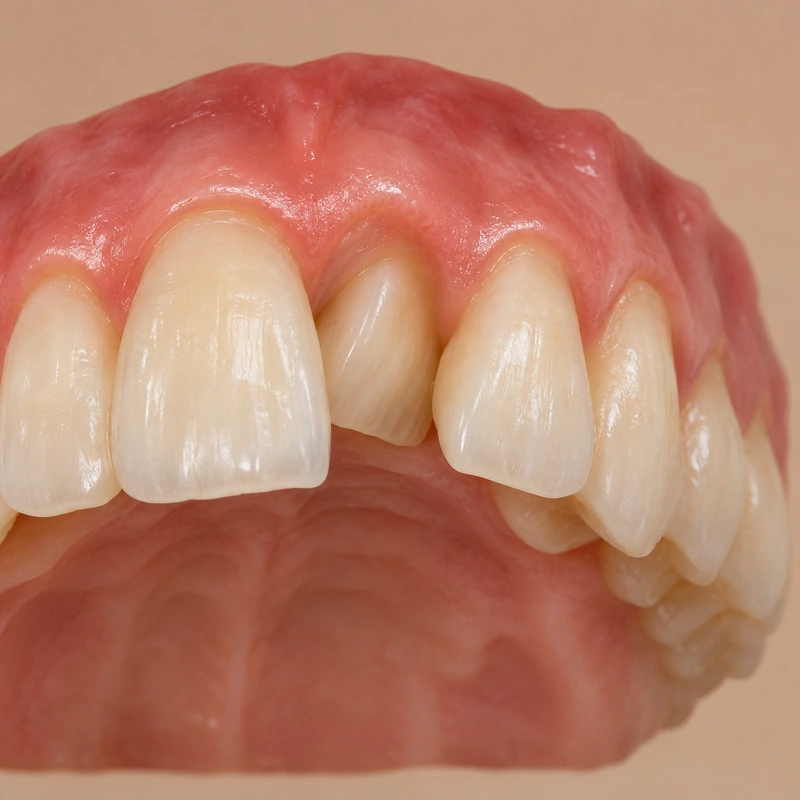
The sideways displacement differs from a tooth being driven along its axis. The teeth may suddenly no longer meet normally.
The socket wall is often injured as well. This can make the displaced tooth unexpectedly immobile.
The clinician assesses the position and repositions the permanent tooth as indicated. Flexible splinting can maintain alignment during initial healing.
The injury can affect both bony support and the pulp's blood supply.
Avoid trying to realign it.
A displaced crown can interfere with normal closure of the teeth.
Three steps. No audio.
Each scene can also be selected manually.

Silent educational film with German on-screen text and simplified teaching images. Not a patient case or a promised treatment outcome. The full English explanation is available as text.
Several teeth moving together with a segment of jawbone can indicate an alveolar fracture. It requires clinical assessment.
The injury can affect both bony support and the pulp's blood supply. Contact a dentist or urgent dental service immediately after displacement.
Avoid trying to realign it. The dentist also checks whether a segment of bone has moved with it.
A displaced crown can interfere with normal closure of the teeth. Do not force them together.
Nerve responses may be temporarily absent after injury. Repeated findings help distinguish recovery from later damage.
A question you could ask
What other injuries were found in the socket or neighbouring teeth?
After a recent dental injury, call a dental practice or an emergency dental service promptly.
Call the practice · 0221 669 401 80Telephone contactSeveral teeth moving together with a segment of jawbone can indicate an alveolar fracture. It requires clinical assessment.
Editorial research: . General information, not an individual diagnosis or treatment recommendation. Teaching illustrations are simplified and do not depict a patient case.
If you turn this on, this website stores which guides you open, separately from advertising preferences. The markers expire after a fixed 30-day period from activation. The list is not sent to us by this feature. You can turn it off here and delete the markers.
Other people using the same browser profile can also see the markers. German and English versions share one marker. Expired entries are removed the next time you open a page with this feature; deleting browser data may remove them earlier. “Viewed” means opened, not read or completed.