How does it differ from cheilitis?
Cheilitis means inflammation of the lip. Sun-induced cheilitis often affects a broader area of the lower lip.

Lip cancer is a malignant growth of the lip, commonly a squamous cell carcinoma. A spot on the lower lip may crust repeatedly, remain open or develop into a firm lump. Other conditions can look similar. A growing lump or an area that repeatedly bleeds spontaneously warrants prompt medical assessment.
For training & practice ↓
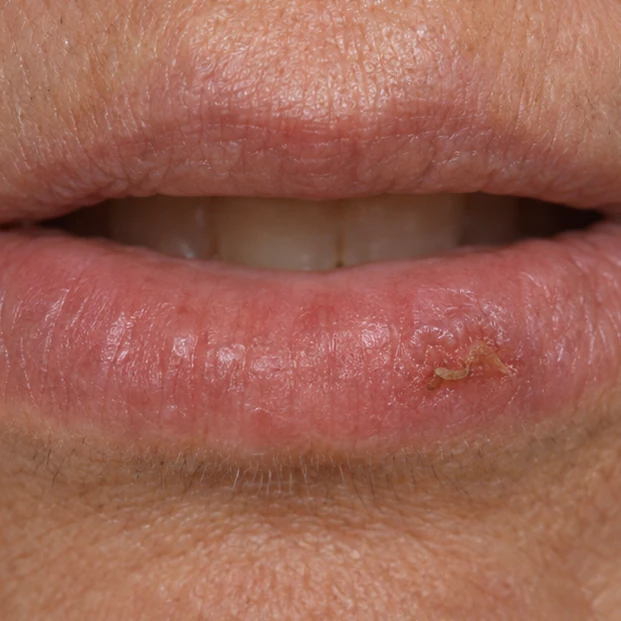
A single repeatedly crusting spot on the lower lip has several possible causes. A persistent or growing area warrants examination.
Long-term ultraviolet exposure can damage the surface of the lower lip. A small firm focus within a wider rough patch deserves particular attention.
When a finding is suspicious, a biopsy can distinguish inflammation, abnormal cell changes and carcinoma.
Cheilitis means inflammation of the lip. Sun-induced cheilitis often affects a broader area of the lower lip.
Yes. Long-term exposure to ultraviolet light matters on the sun-exposed lip. The wet inner lining belongs to the oral cavity. Clinicians record whether the change began on the skin, the red portion of the lip or the wet inner lining.
A dermatologist can assess a change on the outer or red lip.
Three steps. No audio.
Each scene can also be selected manually.

Silent film with English on-screen text and simplified teaching images.
Long-term ultraviolet exposure can damage the surface of the lower lip. A small firm focus within a wider rough patch deserves particular attention.
Cheilitis means inflammation of the lip. Sun-induced cheilitis often affects a broader area of the lower lip. It can feel rough or scaly and can give rise to squamous cell carcinoma. A new firm lump, an area of growth or a persistent sore within that patch needs its own assessment. Actinic cheilitis
Yes. Long-term exposure to ultraviolet light matters on the sun-exposed lip. The wet inner lining belongs to the oral cavity. Clinicians record whether the change began on the skin, the red portion of the lip or the wet inner lining.
A dermatologist can assess a change on the outer or red lip. A dentist or an oral and maxillofacial specialist can assess a change on the inner lining. German oral cancer guidance recommends prompt specialist assessment of any unexplained change in the oral lining that persists for more than two weeks. A biopsy can establish the diagnosis when the finding is suspicious. Oral cavity cancer
A question to ask
Is the change on the vermilion, the skin or the inner wet lining?
A change on the inner lip can be assessed in dental or maxillofacial care. A dermatologist can examine the outer lip.
Choose an appointmentAppointment selection at DoctolibRecord a diffuse scaly patch and any new focal thickening within it separately. Identifying where the lesion began helps direct the referral.
Editorial research: . General information, not an individual diagnosis or treatment recommendation. Teaching illustrations are simplified and do not depict a patient case.
If you turn this on, this website stores which guides you open, separately from advertising preferences. The markers expire after a fixed 30-day period from activation. The list is not sent to us by this feature. You can turn it off here and delete the markers.
Other people using the same browser profile can also see the markers. German and English versions share one marker. Expired entries are removed the next time you open a page with this feature; deleting browser data may remove them earlier. “Viewed” means opened, not read or completed.