Do all the roots of a baby molar resorb at the same rate?
One root can resorb further than another. The position of the developing permanent tooth plays a part. Uneven progression has also been observed on radiographs.

During normal tooth replacement, the body gradually breaks down the roots of a primary tooth. As support is lost the tooth loosens and can fall out. What a child holds afterwards may consist mostly of the crown.
For training & practice ↓
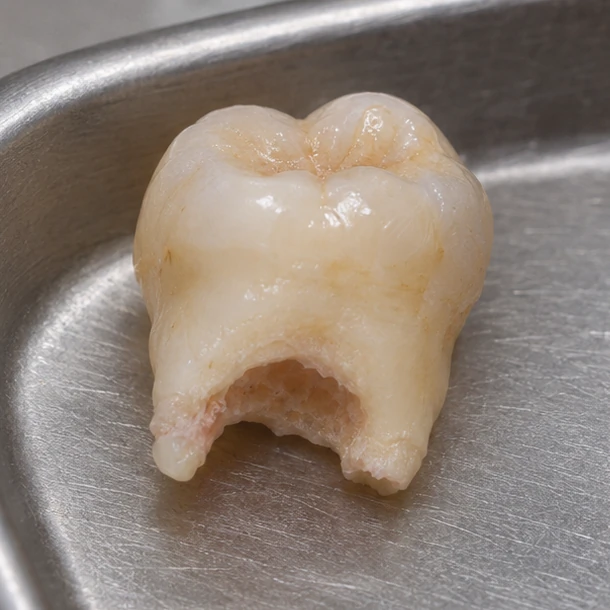
This example illustrates how little root may remain when a baby tooth sheds naturally.
The position of a developing tooth affects which part of a primary root lies in its path.
The team compares eruption and mobility with neighbouring teeth and the other side.
This example illustrates how little root may remain when a baby tooth sheds naturally.
The position of a developing tooth affects which part of a primary root lies in its path.
The team compares eruption and mobility with neighbouring teeth and the other side.
One root can resorb further than another. The position of the developing permanent tooth plays a part. Uneven progression has also been observed on radiographs.
A primary tooth that suddenly moves or changes position after a fall should be assessed. Injury may loosen a tooth even well before it is due to shed.
Have the area checked, particularly if the baby tooth stays firm, becomes painful or the opposite side is much further along. Space, position and eruption help determine whether observation is enough.
Three steps. No audio.
Each scene can also be selected manually.

Silent film with English on-screen text and simplified teaching images.
Timing and any recent impact matter. A sudden change in position after an injury needs assessment.
One root can resorb further than another. The position of the developing permanent tooth plays a part. Uneven progression has also been observed on radiographs.
A primary tooth that suddenly moves or changes position after a fall should be assessed. Injury may loosen a tooth even well before it is due to shed.
Have the area checked, particularly if the baby tooth stays firm, becomes painful or the opposite side is much further along. Space, position and eruption help determine whether observation is enough.
A question to ask
Does this mobility fit normal shedding, or does the permanent successor need a closer look?
Have a tooth loosened by injury or a persistently painful area examined.
Choose an appointmentAppointment selection at DoctolibPhysiological resorption may progress unevenly across root surfaces. Clinical mobility and imaging provide complementary information.
Editorial research: . General information, not an individual diagnosis or treatment recommendation. Teaching illustrations are simplified and do not depict a patient case.
If you turn this on, this website stores which guides you open, separately from advertising preferences. The markers expire after a fixed 30-day period from activation. The list is not sent to us by this feature. You can turn it off here and delete the markers.
Other people using the same browser profile can also see the markers. German and English versions share one marker. Expired entries are removed the next time you open a page with this feature; deleting browser data may remove them earlier. “Viewed” means opened, not read or completed.