What does mesial mean?
Along the arch towards the midline between the central incisors.

Molar mesialisation, also called protraction, moves a molar forwards along the arch towards the dental midline. It can reduce or close a space left by a missing first molar. Available space, roots, supporting bone and bite all affect suitability.
For training & practice ↓
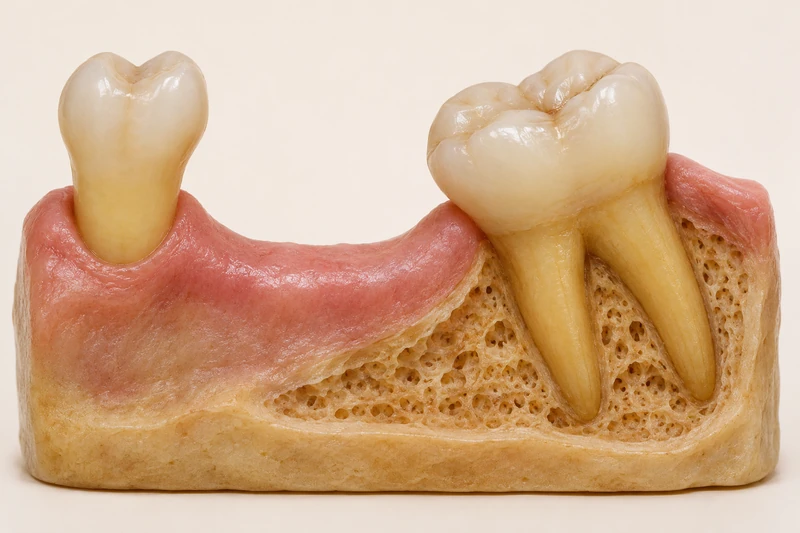
First establish which tooth is absent and how far its neighbour, including the roots, would have to travel. The visible gap is only one part of the assessment.
Pulling a molar forward also places forces on the anchorage. Other teeth or a temporary miniscrew may provide support depending on the goal.
Even where two crowns touch, the roots may not yet be correctly aligned. Final tooth positions and contacts with the opposite arch both matter.
Along the arch towards the midline between the central incisors.
In a common example it is the second molar.
The tooth needs appropriate contacts with the opposing teeth after movement.
Three steps. No audio.
Each scene can also be selected manually.

Silent film with English on-screen text and simplified teaching images.
This moves teeth backwards along the arch, the opposite direction to mesialisation.
Orthodontic closure can be considered for selected gaps. Remaining teeth, supporting bone and bite must suit protraction. The options also differ in the time involved.
In a study of 50 people, lower third molars moved forward spontaneously by varying amounts after the second molar was protracted. This does not precisely predict what an individual wisdom tooth will do.
A crown can tilt into a gap while its roots remain largely in place. Planned space closure includes checking the direction and amount of root movement.
A question to bring along
Which features of my gap favour tooth movement and which favour a replacement?
Ask to compare options with and without a replacement tooth when discussing a posterior gap.
Choose a dental appointmentAppointment selection at DoctolibFeasibility of space closure and the outlook for an adjacent wisdom tooth are separate questions.
Editorial research: . General information, not an individual diagnosis or treatment recommendation. Teaching illustrations are simplified and do not depict a patient case.
If you turn this on, this website stores which guides you open, separately from advertising preferences. The markers expire after a fixed 30-day period from activation. The list is not sent to us by this feature. You can turn it off here and delete the markers.
Other people using the same browser profile can also see the markers. German and English versions share one marker. Expired entries are removed the next time you open a page with this feature; deleting browser data may remove them earlier. “Viewed” means opened, not read or completed.