Cause?
Repeated chewing or biting of the cheek.

Morsicatio buccarum describes changes to the inner cheek caused by repeated chewing or biting of the mucosa. The surface may appear whitish, irregular and ragged. The habit often happens without awareness. Other white or sore mucosal conditions can look similar and need to be excluded when findings are uncertain.
For training & practice ↓
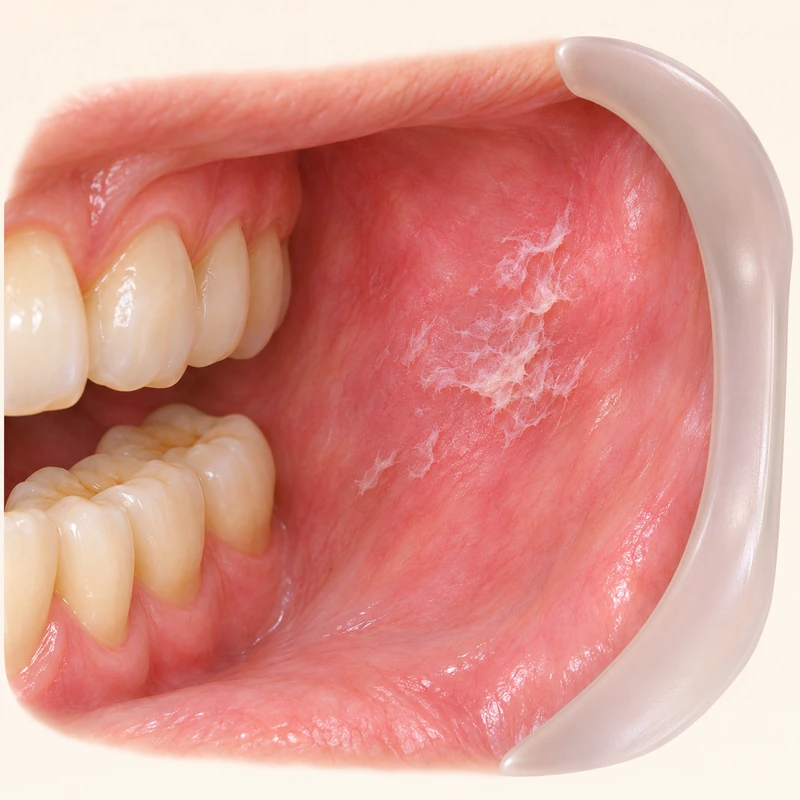
Cheek chewing repeatedly traps mucosa between the teeth. Surface tissue is disrupted, which may produce rough, whitish and ragged areas.
Not everyone notices the chewing. A respectful discussion of situations and symptoms complements examination. Stress may contribute, but appearance cannot diagnose a psychological condition.
Once the diagnosis is established, recognising and changing the habit may help. Persistent uncertain areas, or lesions that become painful, red or ulcerated, need review.
Repeated chewing or biting of the cheek.
No. It often happens unnoticed.
No. Examination is needed.
Three steps. No audio.
Each scene can also be selected manually.

Silent educational film with German on-screen text and simplified teaching images. Not a patient case or a promised treatment outcome. The full English explanation is available as text.
Morsicatio describes repeated irritation with a characteristic surface change. An isolated accidental bite may instead cause an acute wound. Persistent unexplained symptoms in either situation need assessment.
No. Many people barely notice the habit. Blame is unhelpful; identifying common situations and possible mechanical triggers together is more useful.
No. A mucosal finding cannot establish that diagnosis. If the habit is distressing or difficult to interrupt, additional help with behaviour change may be useful.
History, distribution, surface features and progress are considered together. Uncertain findings may require further tests or a biopsy. Scraping it yourself is not a reliable test.
No. Whether mechanical protection may help depends on the individual circumstances. Correct diagnosis comes first; the term does not imply a routine splint prescription.
You can bring this question to your appointment:
Does this fit cheek chewing, and what practical support could reduce the repeated irritation?
An individual examination can clarify the findings and suitable next steps.
Arrange an assessmentAppointment selection at DoctolibMorsicatio describes repeated irritation with a characteristic surface change. An isolated accidental bite may instead cause an acute wound. Persistent unexplained symptoms in either situation need assessment.
Editorial research: . General information, not an individual diagnosis or treatment recommendation. Teaching illustrations are simplified and do not depict a patient case.
If you turn this on, this website stores which guides you open, separately from advertising preferences. The markers expire after a fixed 30-day period from activation. The list is not sent to us by this feature. You can turn it off here and delete the markers.
Other people using the same browser profile can also see the markers. German and English versions share one marker. Expired entries are removed the next time you open a page with this feature; deleting browser data may remove them earlier. “Viewed” means opened, not read or completed.