Which arch?
The upper arch.

A Nance appliance is a usually fixed orthodontic holding and anchorage device for the upper arch. A wire connects bands on the molars to an acrylic pad on the front part of the palate. This support aims to limit unwanted tooth movement or preserve space. It does not make the anchoring teeth immovable.
For training & practice ↓
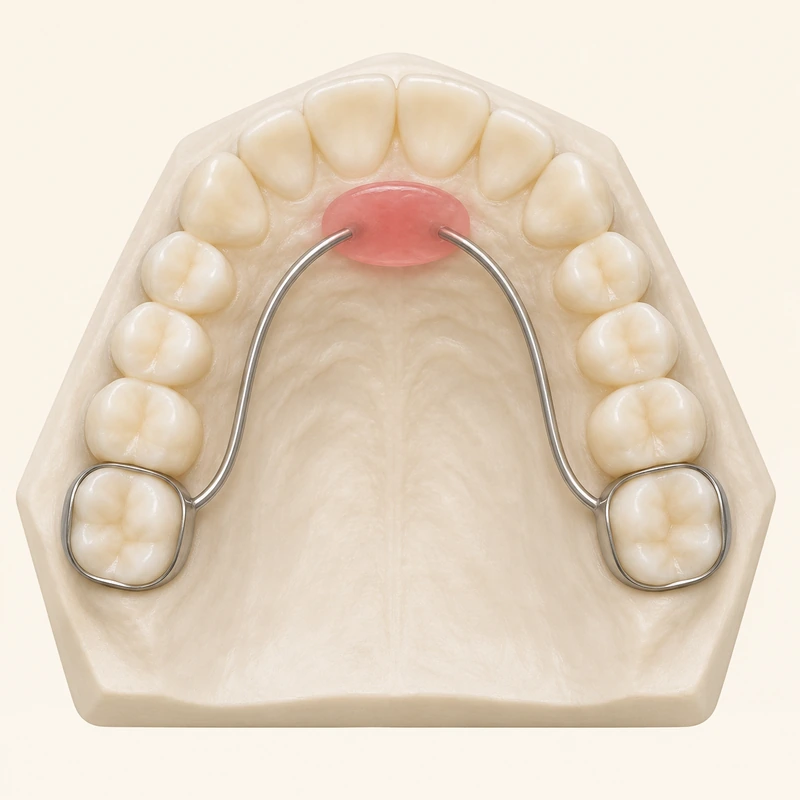
A wire runs from the molar bands to an acrylic pad on the anterior palate. Its position and fit are tailored to the individual mouth.
A conventional Nance appliance supports anchorage. Unlike a pendulum appliance, it has no active springs designed to move upper molars backwards.
Plaque or sore areas can develop around the palatal pad. Pain, swelling or a loose band should be assessed promptly by the treating team.
The upper arch.
No.
No; arrange a check.
Three steps. No audio.
Each scene can also be selected manually.

Silent educational film with German on-screen text and simplified teaching images. Not a patient case or a promised treatment outcome. The full English explanation is available as text.
Both connect upper molars. The characteristic additional feature of a Nance appliance is its acrylic pad on the anterior palate.
The usual fixed design is fitted and removed by the treating team. A loose component should be checked rather than bent back into place at home.
No. A conventional Nance appliance provides support and space control; it is not intended to widen the bony midpalatal suture.
No. Anchorage loss can still occur. The choice of support depends on planned forces, space requirements and the overall treatment plan.
You can bring this question to your appointment:
What space or anchorage should this device preserve, and how will the palate and molars be monitored?
An individual assessment can clarify the findings and whether referral is needed.
Arrange an assessmentAppointment selection at DoctolibBoth connect upper molars. The characteristic additional feature of a Nance appliance is its acrylic pad on the anterior palate.
Editorial research: . General information, not an individual diagnosis or treatment recommendation. Teaching illustrations are simplified and do not depict a patient case.
If you turn this on, this website stores which guides you open, separately from advertising preferences. The markers expire after a fixed 30-day period from activation. The list is not sent to us by this feature. You can turn it off here and delete the markers.
Other people using the same browser profile can also see the markers. German and English versions share one marker. Expired entries are removed the next time you open a page with this feature; deleting browser data may remove them earlier. “Viewed” means opened, not read or completed.