Common site?
Minor salivary glands in the palate.

Necrotising sialometaplasia is a rare benign tissue reaction, usually involving minor salivary glands, often in the palate. A local reduction in blood supply is thought to precede it. It may begin as a swelling and later form an ulcer. Because it can resemble malignancy, careful diagnosis and follow-up are essential.
For training & practice ↓
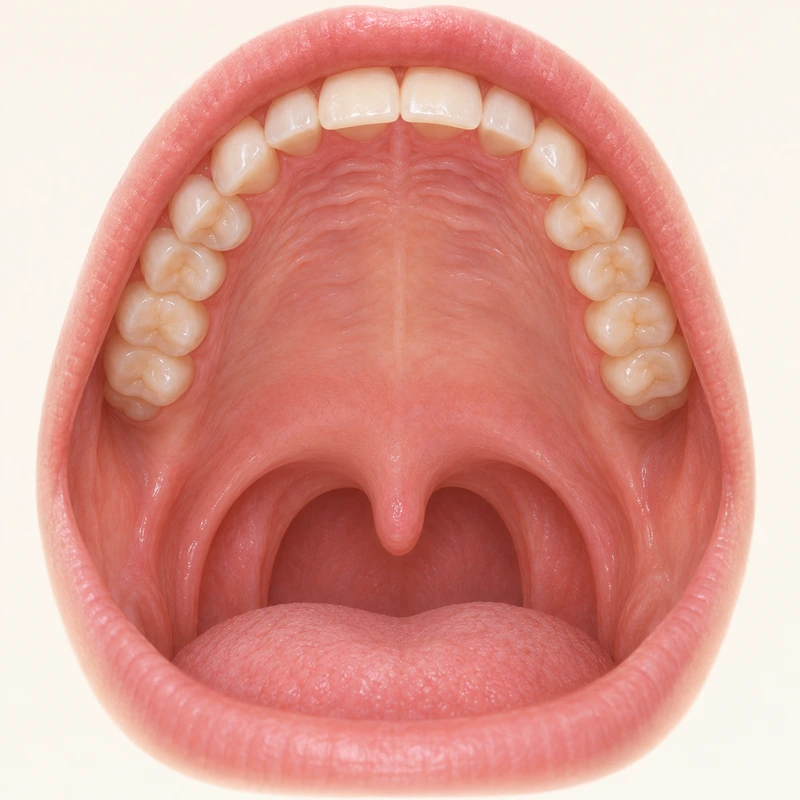
Small salivary glands lie beneath the palatal mucosa. In sialometaplasia, gland tissue can die and cellular structures change; reduced local blood supply is a proposed initiating event.
Palatal swelling or ulceration has several possible causes. Clinical findings and often tissue examination must be considered together so that a tumour is not missed.
Confirmed sialometaplasia can heal spontaneously. Follow-up continues until healing is complete. An unexplained palatal ulcer should not be watched for weeks on an unconfirmed assumption.
Minor salivary glands in the palate.
Yes, once this diagnosis is established.
Other conditions can look similar.
Three steps. No audio.
Each scene can also be selected manually.

Silent educational film with German on-screen text and simplified teaching images. Not a patient case or a promised treatment outcome. The full English explanation is available as text.
Sialadenitis is a general term for inflammation of a salivary gland. Necrotising sialometaplasia describes a particular tissue pattern with glandular necrosis and cellular transformation. The terms are not interchangeable.
No. Necrosis means tissue death and does not specify its cause. Necrotising sialometaplasia is benign, but its clinical and microscopic features may resemble other conditions.
Its benign nature is often not established before diagnostic assessment. An appropriate tissue sample, interpreted alongside the clinical course, helps avoid misdiagnosis.
No. This condition involves a salivary-gland tissue reaction. The cause of a palatal ulcer cannot reliably be established from its size or colour alone.
No. Monitored observation may be appropriate once the diagnosis is established. A diagnostic biopsy is different from extensive surgical removal. Follow-up remains important until healing.
You can bring this question to your appointment:
Is the diagnosis adequately established, and how will complete healing be confirmed?
An individual examination can clarify the findings and suitable next steps.
Arrange an assessmentAppointment selection at DoctolibSialadenitis is a general term for inflammation of a salivary gland. Necrotising sialometaplasia describes a particular tissue pattern with glandular necrosis and cellular transformation. The terms are not interchangeable.
Editorial research: . General information, not an individual diagnosis or treatment recommendation. Teaching illustrations are simplified and do not depict a patient case.
If you turn this on, this website stores which guides you open, separately from advertising preferences. The markers expire after a fixed 30-day period from activation. The list is not sent to us by this feature. You can turn it off here and delete the markers.
Other people using the same browser profile can also see the markers. German and English versions share one marker. Expired entries are removed the next time you open a page with this feature; deleting browser data may remove them earlier. “Viewed” means opened, not read or completed.