Bluish or amber
In this comparison the edges look bluish or warmer depending on the direction of light.

Enamel scatters light differently according to wavelength. Reflected light can appear bluish, while light passing through the edge can look warmer or orange. This difference is called opalescence.
For training & practice ↓
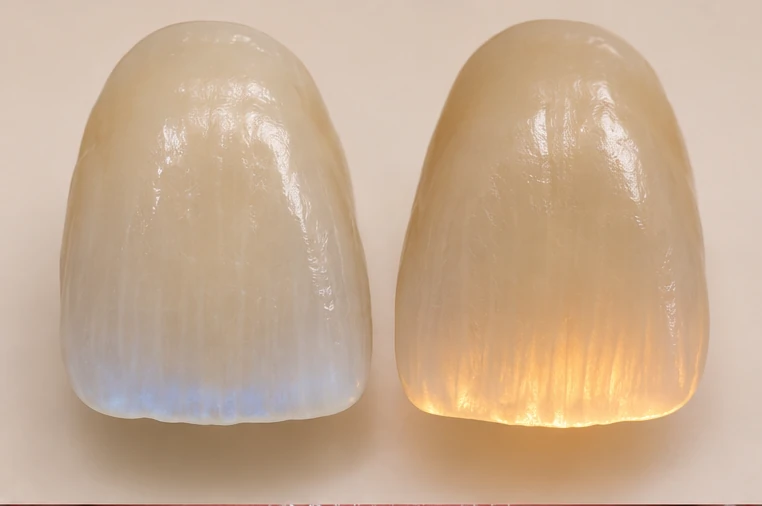
In this comparison the edges look bluish or warmer depending on the direction of light.
Reflected light can give an incisal edge a cooler rim.
Backlighting an incisal edge can make that area appear warm.
In this comparison the edges look bluish or warmer depending on the direction of light.
Reflected light can give an incisal edge a cooler rim.
Backlighting an incisal edge can make that area appear warm.
In this comparison the edges look bluish or warmer depending on the direction of light.
Reflected light can give an incisal edge a cooler rim.
Backlighting an incisal edge can make that area appear warm.
Three steps. No audio.
Each scene can also be selected manually.

Silent film with English on-screen text and simplified teaching images.
This effect can occur in natural enamel. A new discolouration, damage or symptoms should be assessed in their own right. One photograph under a single light source may not explain a change.
This effect can occur in natural enamel. A new discolouration, damage or symptoms should be assessed in their own right. One photograph under a single light source may not explain a change.
Translucency describes how light passes diffusely through a material. Opalescence describes a colour difference between reflected and transmitted light. Materials with similar translucency may show different opalescence.
The edge and body of the tooth behave differently in light. At a try-in it can help to look at shape and lighting from several directions. A single shade value does not describe the edge completely.
A question to ask
Can we compare the planned incisal edge in reflected and transmitted light?
Choose an appointment to discuss your own tooth or restoration.
Choose an appointmentAppointment selection at DoctolibAssess opalescence by comparing reflected and transmitted light. Fluorescence instead involves light emission following excitation.
Editorial research: . General information, not an individual diagnosis or treatment recommendation. Teaching illustrations are simplified and do not depict a patient case.
If you turn this on, this website stores which guides you open, separately from advertising preferences. The markers expire after a fixed 30-day period from activation. The list is not sent to us by this feature. You can turn it off here and delete the markers.
Other people using the same browser profile can also see the markers. German and English versions share one marker. Expired entries are removed the next time you open a page with this feature; deleting browser data may remove them earlier. “Viewed” means opened, not read or completed.