Where is the archwire?
It connects the brackets of a fixed appliance.

An orthodontic archwire is the wire that runs through the brackets of a fixed brace. This system transfers planned forces to the teeth. The wire’s shape, dimensions and material properties depend on the treatment goal and stage. Tooth movement involves biological changes in the supporting tissues; teeth are not simply pushed through unchanged bone.
For training & practice ↓
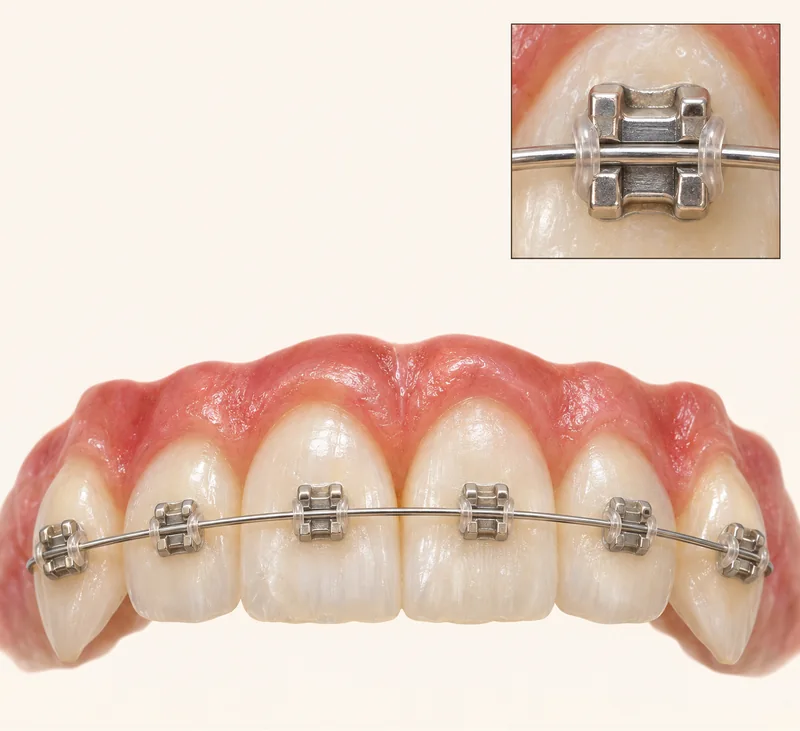
The wire runs through the bracket slots. Small ligatures or a closure on the bracket hold it in place. This connection transfers the planned forces to the teeth.
The root remains connected to the jaw through its supporting tissues. These tissues adapt during orthodontic movement. Its direction and extent cannot reliably be inferred from a wire or photograph alone.
The treating team may adjust or replace the wire during treatment. Report a protruding or broken end. Do not bend, cut or replace the wire yourself.
It connects the brackets of a fixed appliance.
It transfers forces to teeth within a planned system.
Contact the treating team and do not make your own changes to the wire.
Three steps. No audio.
Each scene can also be selected manually.

Silent educational film with German on-screen text and simplified teaching images. Not a patient case or a promised treatment outcome. The full English explanation is available as text.
The archwire transfers forces within an active treatment system. A retainer is intended to stabilise the resulting tooth positions. Similar material does not mean the same function.
Different treatment stages can require different wire properties. A change does not automatically mean more force or faster treatment. The decision depends on the clinical findings and progress so far.
Not necessarily. Material, shape, activation and the bracket connection matter as well as thickness. Greater force is not a general route to better or faster treatment.
Contact the treating team. Orthodontic wax may temporarily cover a rubbing area while you seek advice. Persistent or severe pain and injuries need assessment; wax does not repair the wire.
No. An archwire is part of an active fixed appliance. A retainer helps stabilise teeth after active correction. A fixed retainer may also be made of wire, but it has a different purpose.
You can bring this question to your appointment:
What is this archwire intended to do at my current treatment stage?
Discuss questions about an existing archwire with your treating orthodontic team.
Arrange an assessmentAppointment selection at DoctolibThe archwire transfers forces within an active treatment system. A retainer is intended to stabilise the resulting tooth positions. Similar material does not mean the same function.
Editorial research: . General information, not an individual diagnosis or treatment recommendation. Teaching illustrations are simplified and do not depict a patient case.