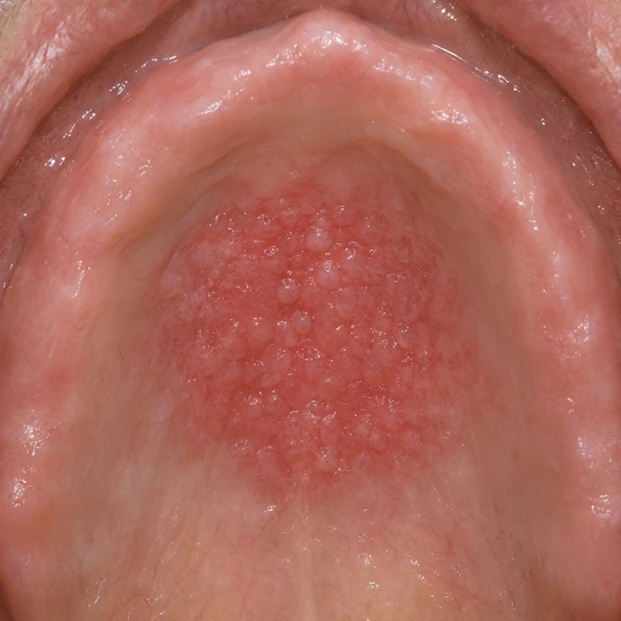
What can cause tiny bumps beneath an upper denture?
Inflammatory papillary hyperplasia is a usually benign overgrowth of the oral lining. Closely packed little projections give the hard palate beneath a denture a pebbled surface. The area may look red while causing little discomfort.
Continuous denture wear, deposits on the fitting surface and a poor fit can stress the lining. Yeasts may also contribute. An examination therefore includes the palate and the surface of the denture resting against it.
02
Does every red patch beneath a denture represent an overgrowth?
Denture stomatitis may appear as flat redness. The papillary form also has small projections of tissue. A single sore or a new lump on one side needs assessment in its own right.
03
Will cleaning my denture solve it?
Cleaning, breaks from wear and correcting points of irritation can form part of treatment. Established tissue overgrowth may persist. The examining clinician can advise whether additional treatment or a tissue sample is appropriate.
Knowledge in motion
Explained in 36 seconds.
Three steps. No audio. Each scene can also be selected manually.
Silent film with English on-screen text and simplified teaching images.
The supporting surface may look red without tissue overgrowth. This comparison illustrates one appearance of denture stomatitis.
Quick answersWhat contributes to these bumps?
Continuous denture wear, deposits on the fitting surface and a poor fit can stress the lining. Yeasts may also contribute. An examination therefore includes the palate and the surface of the denture resting against it.
Does every red patch beneath a denture represent an overgrowth?
Denture stomatitis may appear as flat redness. The papillary form also has small projections of tissue. A single sore or a new lump on one side needs assessment in its own right.
Will cleaning my denture solve it?
Cleaning, breaks from wear and correcting points of irritation can form part of treatment. Established tissue overgrowth may persist. The examining clinician can advise whether additional treatment or a tissue sample is appropriate.
At the practice
At the examination
A question to ask
Does the area of change correspond to the denture-bearing surface?
When a new palatal change appears, bring the denture so both surfaces can be examined.
Learning layer for training & practiceUnderstand terminology and deepen knowledge
Papillary
Growing in small, projecting ridges or bumps.
Denture base
Part of the denture that rests against the mucosa.
Make the distinction
Describe the surface and its relationship to the denture-bearing area. Yeast may also be present. Appearance in a photograph alone establishes neither the cause nor a need for antifungal medication.
Editorial research: . General information, not an individual diagnosis or treatment recommendation. Teaching illustrations are simplified and do not depict a patient case.
If you turn this on, this website stores which guides you open, separately from advertising preferences. The markers expire after a fixed 30-day period from activation. The list is not sent to us by this feature. You can turn it off here and delete the markers.
Other people using the same browser profile can also see the markers. German and English versions share one marker. Expired entries are removed the next time you open a page with this feature; deleting browser data may remove them earlier. “Viewed” means opened, not read or completed.
With your consent, we use Google Ads to attribute clicks on our appointment booking links and phone number to adverts. Google processes technical usage data and sets or reads cookies. Data may be processed in the USA. Advertising measurement does not load without your consent. Google Analytics and personalised advertising are not enabled. Google Maps loads separately when you choose to open the map. You can change your choice here at any time.