When is the term used?
When reassessing a site after treatment.

A residual pocket is a site where probing still shows increased depth after the initial phase of periodontal treatment. At reassessment the team compares the reading with the original chart and checks carefully for bleeding on probing. These findings help decide whether further cleaning, another treatment step or closer maintenance is appropriate.
For training & practice ↓
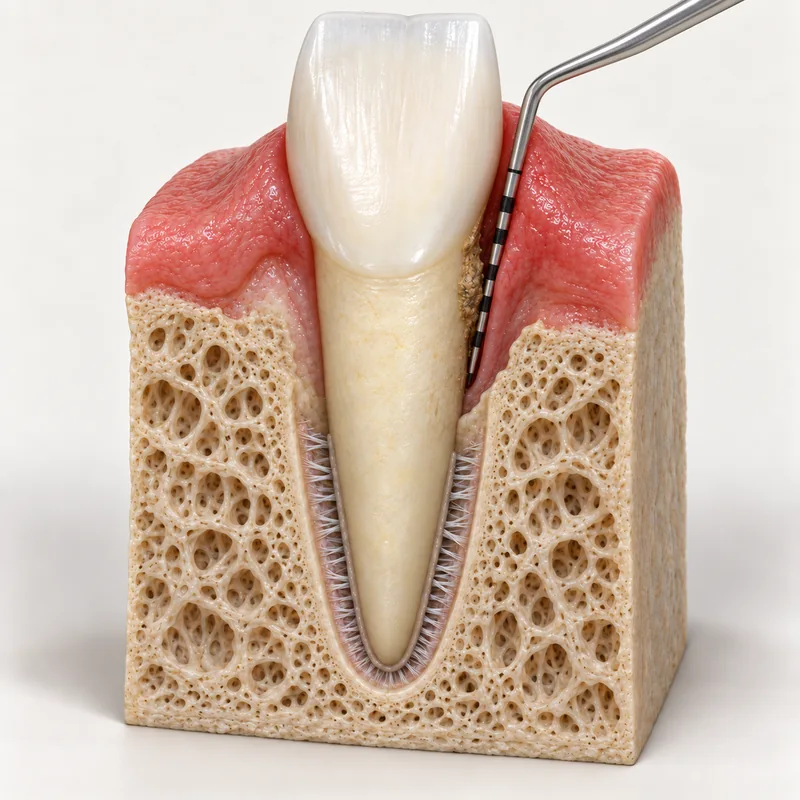
Measuring in the same position helps the team compare the new depth with the original reading.
At teeth with several roots, the space between the roots can make both treatment and cleaning more difficult.
Depth, bleeding and previous measurements inform the follow-up plan for this site.
Measuring in the same position helps the team compare the new depth with the original reading.
At teeth with several roots, the space between the roots can make both treatment and cleaning more difficult.
Depth, bleeding and previous measurements inform the follow-up plan for this site.
When reassessing a site after treatment.
The current reading and earlier measurements at that site.
The next steps depend on the overall findings.
Three steps. No audio.
Each scene can also be selected manually.

Silent film with English on-screen text and simplified teaching images.
The EFP guideline uses pockets over 4 mm that bleed or deep pockets of 6 mm or more as signs that treatment endpoints have not been met. These findings alone do not determine a specific surgical decision.
A site may already be shallower and still need further attention. The team considers how each site has changed, how many deep pockets remain and whether they bleed when probed.
The remaining pocket is assessed with the other findings first. Another round of cleaning below the gum may be appropriate. Surgery is a possible option at selected deep sites that are difficult to access.
The team can show you which brush fits the accessible space between your teeth. Deep pockets are treated professionally. Probing or scraping them yourself with a metal instrument can injure the tissues.
A question to ask
Which site has become shallower, and which still bleeds on probing?
You can arrange an examination to discuss your individual findings.
Choose an appointmentAppointment selection at DoctolibThe EFP guideline uses pockets over 4 mm that bleed or deep pockets of 6 mm or more as signs that treatment endpoints have not been met. These findings alone do not determine a specific surgical decision.
Editorial research: . General information, not an individual diagnosis or treatment recommendation. Teaching illustrations are simplified and do not depict a patient case.
If you turn this on, this website stores which guides you open, separately from advertising preferences. The markers expire after a fixed 30-day period from activation. The list is not sent to us by this feature. You can turn it off here and delete the markers.
Other people using the same browser profile can also see the markers. German and English versions share one marker. Expired entries are removed the next time you open a page with this feature; deleting browser data may remove them earlier. “Viewed” means opened, not read or completed.