Which tissue covers the bone?
The gum covers the bone crest.

During bone sounding, the dentist uses a fine probe under local anaesthesia to feel the bone beneath the gum. The distance is measured from a chosen reference point. One reason is to plan crown lengthening when the position of the bone relative to a proposed crown margin matters.
For training & practice ↓
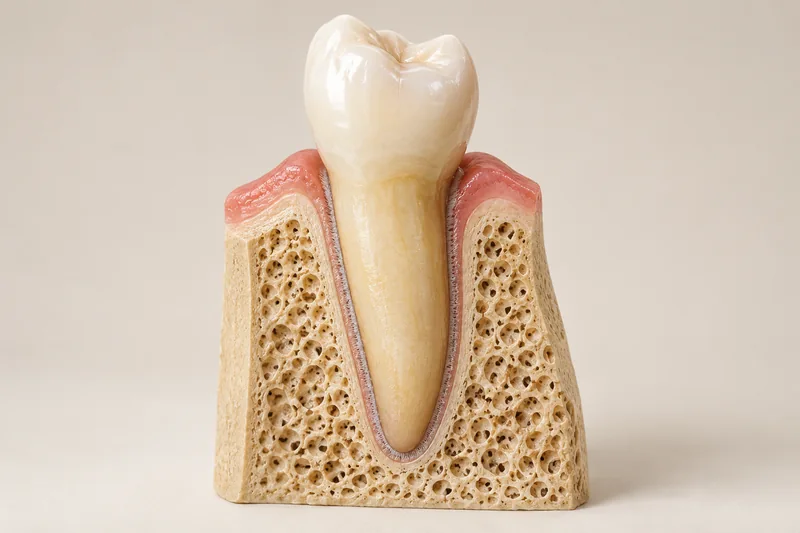
In the model you can see bone alongside the root. In the mouth the gum covers that crest.
The markings allow a distance to be read. The team first chooses a reference point.
Here the probe lies in the gum crevice. Bone sounding specifically uses the firm bone surface as its endpoint.
In the model you can see bone alongside the root. In the mouth the gum covers that crest.
The markings allow a distance to be read. The team first chooses a reference point.
Here the probe lies in the gum crevice. Bone sounding specifically uses the firm bone surface as its endpoint.
The gum covers the bone crest.
At a chosen reference, for example a point on the tooth.
It is a targeted examination for a particular planning question.
Three steps. No audio.
Each scene can also be selected manually.

Silent film with English on-screen text and simplified teaching images.
Gum-margin-to-bone and restoration-margin-to-bone measurements start at different points. Each value needs a specified reference.
For a pocket measurement the probe follows the space between tooth and gum. Sounding specifically seeks contact with bone. The two measurements answer different questions.
The probe passes through soft tissue during this examination, so the site is usually numbed. Ask which area will be measured and what decision the information will help with.
It gives distances at selected points. The dentist interprets them alongside other examination findings and imaging when indicated.
A question to ask
Which decision depends on the distance to the bone in my case?
You can arrange an examination to discuss your individual findings.
Choose an appointmentAppointment selection at DoctolibGum-margin-to-bone and restoration-margin-to-bone measurements start at different points. Each value needs a specified reference.
Editorial research: . General information, not an individual diagnosis or treatment recommendation. Teaching illustrations are simplified and do not depict a patient case.
If you turn this on, this website stores which guides you open, separately from advertising preferences. The markers expire after a fixed 30-day period from activation. The list is not sent to us by this feature. You can turn it off here and delete the markers.
Other people using the same browser profile can also see the markers. German and English versions share one marker. Expired entries are removed the next time you open a page with this feature; deleting browser data may remove them earlier. “Viewed” means opened, not read or completed.