Should I speak unusually slowly?
Normal speech and deliberately repeated sounds provide different information.

A phonetic try-in uses selected sounds and everyday speech to assess how the teeth, tongue and lips work together. With a wax denture setup, the dentist can still change features such as the position or length of the front teeth and the palatal contours.
For training & practice ↓
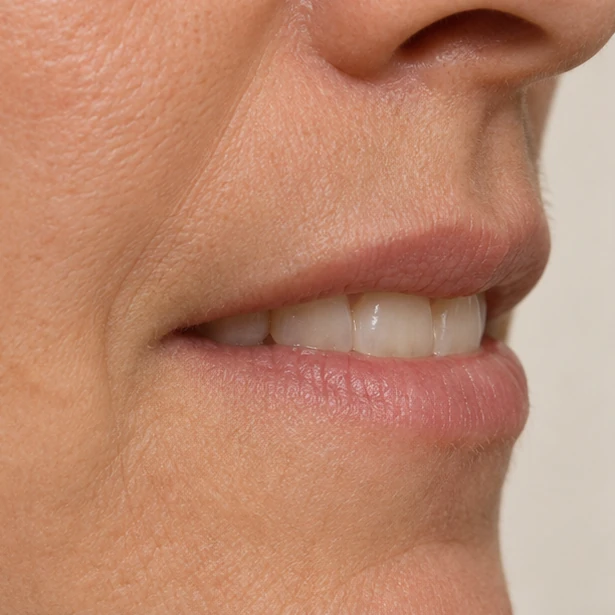
For an F sound the upper incisal edges approach the lower lip. The dentist observes how the tooth position and lip contact fit your usual pronunciation.
The upper and lower teeth come close together during an S sound. Tongue position, front-tooth arrangement and the remaining speaking space all matter.
If a word sounds unfamiliar, repeat it at your usual pace. An adjusted wax setup can then be tested again during speech.
Normal speech and deliberately repeated sounds provide different information.
The tongue, lips and lower jaw all move during speech.
The dental check concerns the contribution of the restoration to articulation.
Three steps. No audio.
Each scene can also be selected manually.

Silent film with English on-screen text and simplified teaching images.
Captures a jaw relationship for prosthetic planning.
Such observations are useful. The dentist can check tooth position, palatal shape and bite. A single sound cannot identify the exact cause on its own.
Tongue space, palatal contour, tooth position and adaptation can all contribute. Arrange a review if speech remains clearly altered.
Yes. Names, words you use at work or a sentence that feels difficult can complement the selected sounds and make the issue easier to discuss.
A question to bring along
Could we try the words in which the new teeth feel most noticeable?
Persistent changes in speech can be discussed at a denture review.
Choose a dental appointmentAppointment selection at DoctolibClosest speaking space and jaw separation at rest are measured in different situations.
Editorial research: . General information, not an individual diagnosis or treatment recommendation. Teaching illustrations are simplified and do not depict a patient case.
If you turn this on, this website stores which guides you open, separately from advertising preferences. The markers expire after a fixed 30-day period from activation. The list is not sent to us by this feature. You can turn it off here and delete the markers.
Other people using the same browser profile can also see the markers. German and English versions share one marker. Expired entries are removed the next time you open a page with this feature; deleting browser data may remove them earlier. “Viewed” means opened, not read or completed.