What makes it a trial stage?
The teeth are still held in wax.

At a wax try-in, the artificial teeth are temporarily set in wax. You can see how their position looks with your lips and face. The clinician also checks the bite and how you speak with the trial arrangement.
For training & practice ↓
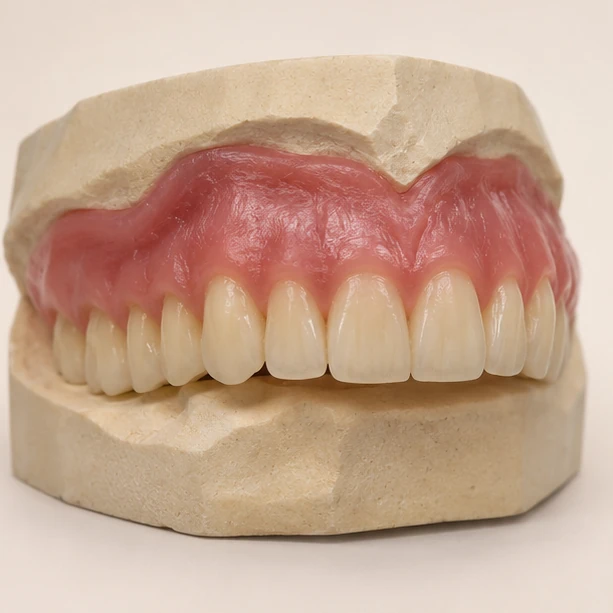
Wax holds the denture teeth on a temporary base. Their position can still be changed at the laboratory before final processing.
Use a mirror to discuss the midline, shade and visible tooth length. The lips reveal different parts of the front teeth at rest and when smiling.
The clinician examines how the two rows of teeth meet. A difficulty with speech or closure may lead to a change in the setup and another check.
The teeth are still held in wax.
A photo showing features of your previous teeth that mattered to you.
A particular word or movement where tooth position or lip contact feels awkward.
Three steps. No audio.
Each scene can also be selected manually.

Silent film with English on-screen text and simplified teaching images.
The try-in has artificial teeth. A wax rim used to record jaw relations initially has a smooth surface without individual teeth.
It is a trial version with adjustable tooth positions. After processing, the final fit against the tissues and the way the teeth meet are checked again.
Yes. Show whether you mean the shape of one tooth or how much of several teeth shows beneath the lip. An earlier photograph may help explain your preference.
A conventional wax setup is for a supervised try-in. Eating can distort it. The clinician guides you through speaking, smiling and gently closing your mouth.
A question to bring along
Can we compare how much tooth shows at rest and when I smile?
Photos and a previous denture can help explain your preferences during a consultation.
Choose a dental appointmentAppointment selection at DoctolibThe appearance in the face complements the clinical bite check. Both are considered before processing.
Editorial research: . General information, not an individual diagnosis or treatment recommendation. Teaching illustrations are simplified and do not depict a patient case.
If you turn this on, this website stores which guides you open, separately from advertising preferences. The markers expire after a fixed 30-day period from activation. The list is not sent to us by this feature. You can turn it off here and delete the markers.
Other people using the same browser profile can also see the markers. German and English versions share one marker. Expired entries are removed the next time you open a page with this feature; deleting browser data may remove them earlier. “Viewed” means opened, not read or completed.