What is polishing paste for?
Targeted professional surface treatment.

Polishing paste contains finely dispersed polishing or abrasive particles for professional surface treatment. Depending on the product, it is used when cleaning natural teeth or polishing restorations; these uses are not freely interchangeable.
For training & practice ↓
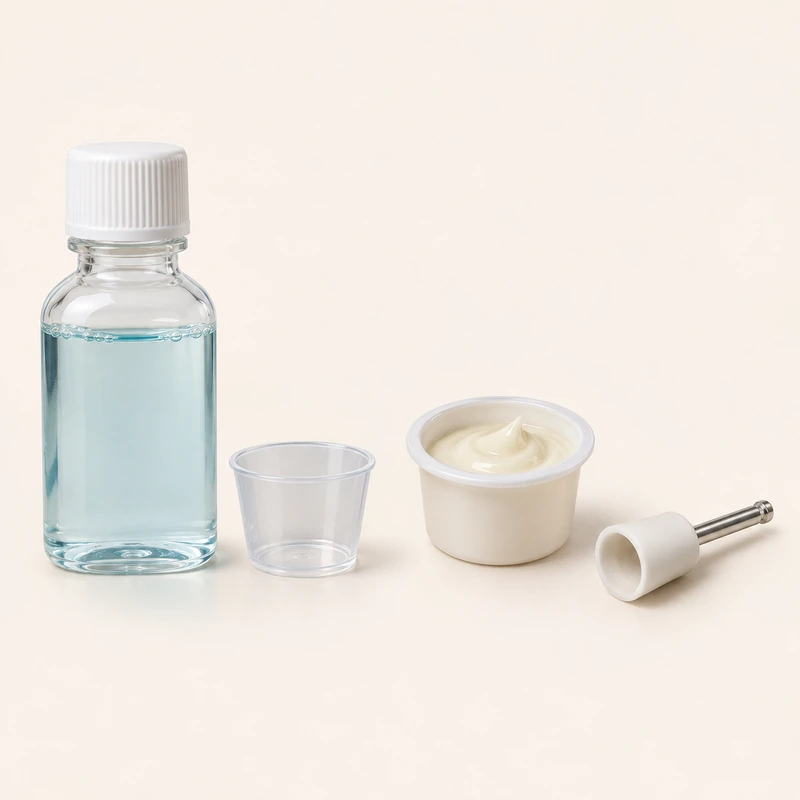
Cleaning may involve removing external stains. With a restoration, the aim may be the final surface finish. Different products and procedures are selected for these tasks.
Enamel, exposed root surfaces, composite and ceramic do not respond identically. Laboratory studies show product- and material-dependent effects on roughness and gloss. Suitability for the particular surface therefore matters.
More pressure or a coarser paste does not automatically improve results. Polishing does not replace hard-calculus removal or treatment of caries or a damaged filling.
Targeted professional surface treatment.
Not automatically; the specific material matters.
No, have the cause and suitable treatment assessed.
Three steps. No audio.
Each scene can also be selected manually.

Silent educational film with German on-screen text and simplified teaching images. Not a patient case or a promised treatment outcome. The full English explanation is available as text.
Cleaning natural teeth and finishing a restorative material are different tasks. The product must be suitable for its intended use.
No. Professional polishing pastes and everyday toothpastes have different purposes and instructions. Do not independently use a professional product at home.
No. Laboratory specimens show differing results. A paste may suit one material and adversely affect another.
No. Polishing treats the surface and, where relevant, external stains. Bleaching changes tooth colour chemically.
Composition depends on the product. The name alone does not establish fluoride content or adequate caries protection.
Have it examined. Whether polishing, adjustment or another treatment is appropriate depends on the findings.
You can bring this question to your appointment:
Which material is being polished, and which product is intended for it?
Discuss which cleaning approach fits your findings.
Discuss dental careAppointment selection at DoctolibCleaning natural teeth and finishing a restorative material are different tasks. The product must be suitable for its intended use.
Editorial research: . General information, not an individual diagnosis or treatment recommendation. Teaching illustrations are simplified and do not depict a patient case.
If you turn this on, this website stores which guides you open, separately from advertising preferences. The markers expire after a fixed 30-day period from activation. The list is not sent to us by this feature. You can turn it off here and delete the markers.
Other people using the same browser profile can also see the markers. German and English versions share one marker. Expired entries are removed the next time you open a page with this feature; deleting browser data may remove them earlier. “Viewed” means opened, not read or completed.