Is polyether the same as silicone?
No. They are different classes of elastomeric impression materials; instructions cannot simply be transferred between them.

Dental polyether is an elastomeric impression material that sets chemically after its components are mixed. It is used to record precise negative forms. Wettability, stiffness after setting and appropriate removal are important selection factors.
For training & practice ↓
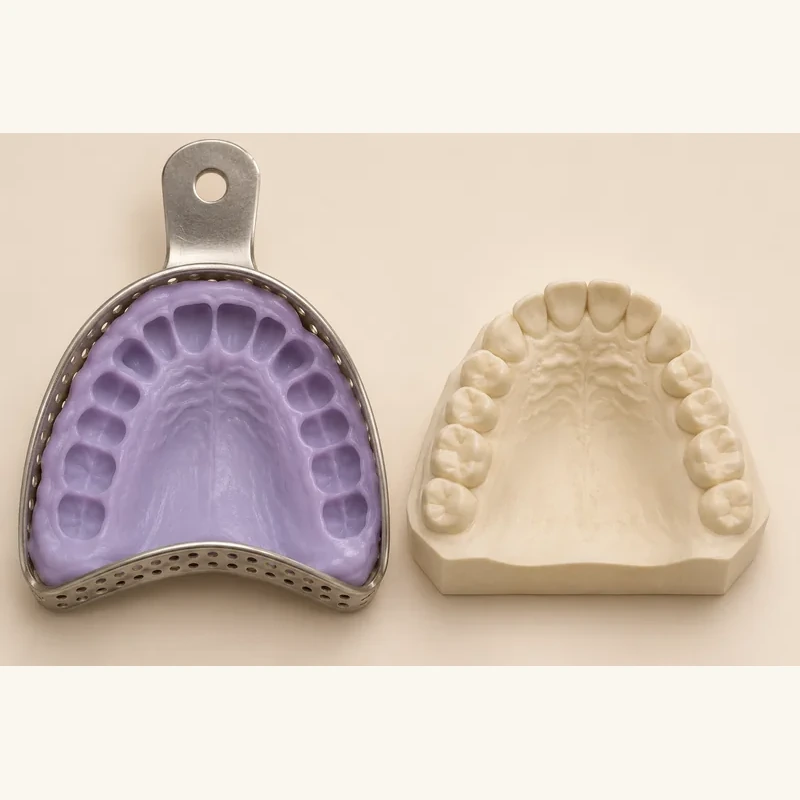
Polyether can wet moist surfaces well. Blood and pools of fluid still need appropriate control.
The set material can be relatively stiff. Undercuts and vulnerable or loose restorations require consideration.
Disinfection and storage follow product instructions. Unsuitable moisture or solvents can alter the impression.
No. They are different classes of elastomeric impression materials; instructions cannot simply be transferred between them.
It describes good wettability by water. It does not mean that blood or pooled saliva are irrelevant during impression taking.
Material may mechanically lock into them. The clinician therefore plans a suitable material and any protective measures needed for removal.
Three steps. No audio.
Each scene can also be selected manually.

Silent educational film with German on-screen text and simplified teaching images. Not a patient case or a promised treatment outcome. The full English explanation is available as text.
Wetting during impression taking is a different property from dimensional stability during prolonged immersion.
No. They are different classes of elastomeric impression materials; instructions cannot simply be transferred between them.
It describes good wettability by water. It does not mean that blood or pooled saliva are irrelevant during impression taking.
Material may mechanically lock into them. The clinician therefore plans a suitable material and any protective measures needed for removal.
Not as a general rule. Dry storage is specified for the referenced product; unsuitable damp storage can affect shape.
Yes, using a suitable, material-compatible method. The prescribed contact time should not be extended arbitrarily.
You can raise this editorially suggested question during your consultation.
Which features of my teeth and restorations matter when taking an impression?
Which features of my teeth and restorations matter when taking an impression?
Request a consultationAppointment selection at DoctolibAccuracy depends on material, preparation, removal and subsequent handling together.
Editorial research: . General information, not an individual diagnosis or treatment recommendation. Teaching illustrations are simplified and do not depict a patient case.
If you turn this on, this website stores which guides you open, separately from advertising preferences. The markers expire after a fixed 30-day period from activation. The list is not sent to us by this feature. You can turn it off here and delete the markers.
Other people using the same browser profile can also see the markers. German and English versions share one marker. Expired entries are removed the next time you open a page with this feature; deleting browser data may remove them earlier. “Viewed” means opened, not read or completed.