Does every child have them?
No. Size and distribution vary between children and between arches. A gap’s presence or absence on its own does not reliably predict how much space the permanent teeth will need.

Primate spaces are small gaps characteristically found beside baby canines. In the upper arch they are usually in front of the canine towards the midline. In the lower arch they are usually behind the canine towards the first primary molar. These spaces may be part of normal development.
For training & practice ↓
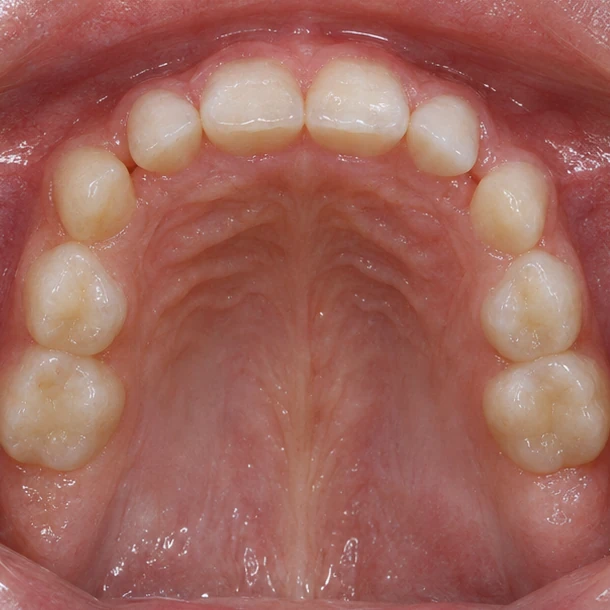
The teaching view shows a small space between an upper lateral incisor and canine.
The canine lies at the transition from front to back teeth and is the landmark for describing the gap.
A single gap gives limited information about future alignment. Both arches are assessed together.
The teaching view shows a small space between an upper lateral incisor and canine.
The canine lies at the transition from front to back teeth and is the landmark for describing the gap.
A single gap gives limited information about future alignment. Both arches are assessed together.
No. Size and distribution vary between children and between arches. A gap’s presence or absence on its own does not reliably predict how much space the permanent teeth will need.
With a primate space the neighbouring baby teeth are still present. If a tooth is missing after injury, decay or extraction, that gap has a different history and may need separate assessment.
A typical small developmental gap is not in itself a reason to close space. Where there is doubt, the number of teeth, bite and developmental stage all matter.
Three steps. No audio.
Each scene can also be selected manually.

Silent film with English on-screen text and simplified teaching images.
A developmental space can occur in a complete arch. Early loss leaves a site previously occupied by a tooth.
No. Size and distribution vary between children and between arches. A gap’s presence or absence on its own does not reliably predict how much space the permanent teeth will need.
With a primate space the neighbouring baby teeth are still present. If a tooth is missing after injury, decay or extraction, that gap has a different history and may need separate assessment.
A typical small developmental gap is not in itself a reason to close space. Where there is doubt, the number of teeth, bite and developmental stage all matter.
A question to ask
Is the full set of baby teeth present and is this gap expected at this stage?
Point out a new gap at the check-up, particularly after injury or early tooth loss.
Choose an appointmentAppointment selection at DoctolibThe typical space is mesial to the upper baby canine and distal to the lower one. Mesial means towards the midline of the arch.
Editorial research: . General information, not an individual diagnosis or treatment recommendation. Teaching illustrations are simplified and do not depict a patient case.
If you turn this on, this website stores which guides you open, separately from advertising preferences. The markers expire after a fixed 30-day period from activation. The list is not sent to us by this feature. You can turn it off here and delete the markers.
Other people using the same browser profile can also see the markers. German and English versions share one marker. Expired entries are removed the next time you open a page with this feature; deleting browser data may remove them earlier. “Viewed” means opened, not read or completed.