What needs protection?
The tooth surface being treated.

With relative moisture control, the team uses tools such as cotton rolls and suction to keep saliva and other fluids away from the working area. The tooth still communicates with the rest of the mouth. The key question is whether the surface can be kept sufficiently clean and dry.
For training & practice ↓
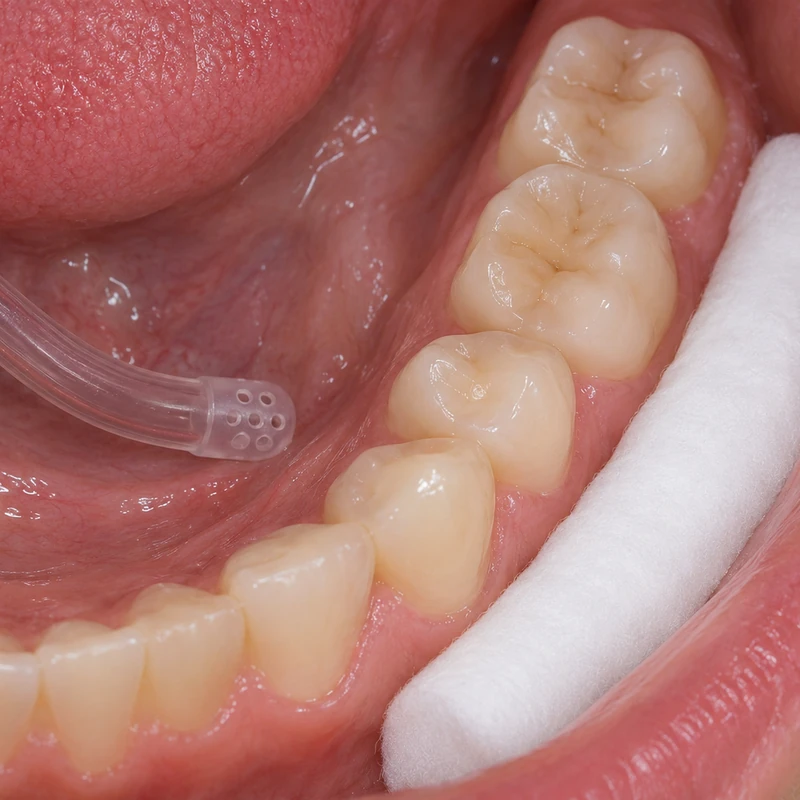
The cotton roll lies beside the teeth. Suction removes fluid before it reaches the working area.
Before adhesive is applied, the surface must allow treatment according to the material instructions. Saliva or blood can interfere with bonding.
A rubber dam separates one or more teeth from the rest of the mouth with a sheet. This gives a different form of isolation.
The tooth surface being treated.
To maintain its ability to absorb fluid.
The planned procedure and conditions at the site.
Three steps. No audio.
Each scene can also be selected manually.

Silent film with English on-screen text and simplified teaching images.
Relative isolation does not place an isolating sheet around the treated teeth.
No. It describes the method and the absence of complete separation from the mouth. The bonding site must still meet the requirements of the material.
A saturated roll absorbs less fluid. The team monitors it and adjusts suction or isolation as needed.
The dentist may choose a rubber dam when cotton rolls cannot maintain stable isolation or the procedure needs additional protection. Root canal treatment has its own requirements.
A question to bring along
How will the deep area of my tooth be kept dry during bonding?
When a filling is planned, ask why a particular method of isolation is being used.
Choose an appointmentAppointment selection at DoctolibThe direct composite guideline discusses both relative and rubber dam isolation. Suitability depends on the situation.
Editorial research: . General information, not an individual diagnosis or treatment recommendation. Teaching illustrations are simplified and do not depict a patient case.
If you turn this on, this website stores which guides you open, separately from advertising preferences. The markers expire after a fixed 30-day period from activation. The list is not sent to us by this feature. You can turn it off here and delete the markers.
Other people using the same browser profile can also see the markers. German and English versions share one marker. Expired entries are removed the next time you open a page with this feature; deleting browser data may remove them earlier. “Viewed” means opened, not read or completed.