Where is the filling?
In a prepared recess at the root end.

A root-end filling seals the end of a root canal during surgery. It is placed from the root-tip side to close the opening between the canal system and the surrounding tissues.
For training & practice ↓
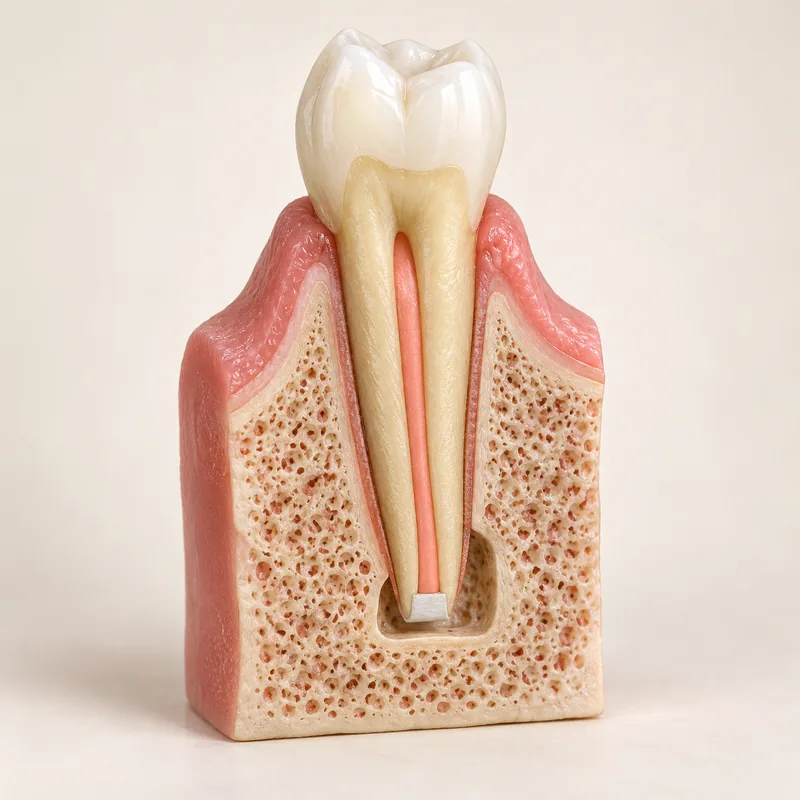
During apical surgery the affected area is accessed surgically. Removing the tip leaves a new root-end surface.
Filling material is placed in a prepared recess in the cut root surface. It seals the very end of the existing root filling.
Symptoms and follow-up images help assess the tissues around the root end. Bone needs time to remodel.
In a prepared recess at the root end.
Retreatment through the crown and surgical access.
Healing around the root evolves over time.
Three steps. No audio.
Each scene can also be selected manually.

Silent film with English on-screen text and simplified teaching images.
Resecting the tip and filling the prepared root-end cavity are distinct steps.
Conventional treatment accesses the canal through the crown. A root-end filling is placed from the opposite end of the tooth.
Persistent symptoms after root filling call for investigation. If the canal can be reached again through the crown, retreatment can be an alternative to surgery.
Symptoms matter, as do changes in the previously affected bone on successive X-rays. An early image alone cannot establish the final result.
A question to bring along
Why might access through the tip or through the crown be preferable in my case?
Discuss the cause and available approaches if a root-filled tooth gives you trouble.
Choose an appointmentAppointment selection at DoctolibAn apical plug can also be placed through the crown. Its location alone does not tell you the access route.
Editorial research: . General information, not an individual diagnosis or treatment recommendation. Teaching illustrations are simplified and do not depict a patient case.
If you turn this on, this website stores which guides you open, separately from advertising preferences. The markers expire after a fixed 30-day period from activation. The list is not sent to us by this feature. You can turn it off here and delete the markers.
Other people using the same browser profile can also see the markers. German and English versions share one marker. Expired entries are removed the next time you open a page with this feature; deleting browser data may remove them earlier. “Viewed” means opened, not read or completed.