Where does it form?
At an air-exposed resin surface during curing.

The oxygen-inhibited layer is a thin, less completely cured surface layer of resin-based dental materials. Oxygen in the air can interfere with polymerisation at the exposed surface. This explains tackiness during placement without necessarily meaning that the whole filling remains soft. An intermediate layer and the final outer surface have different requirements.
For training & practice ↓
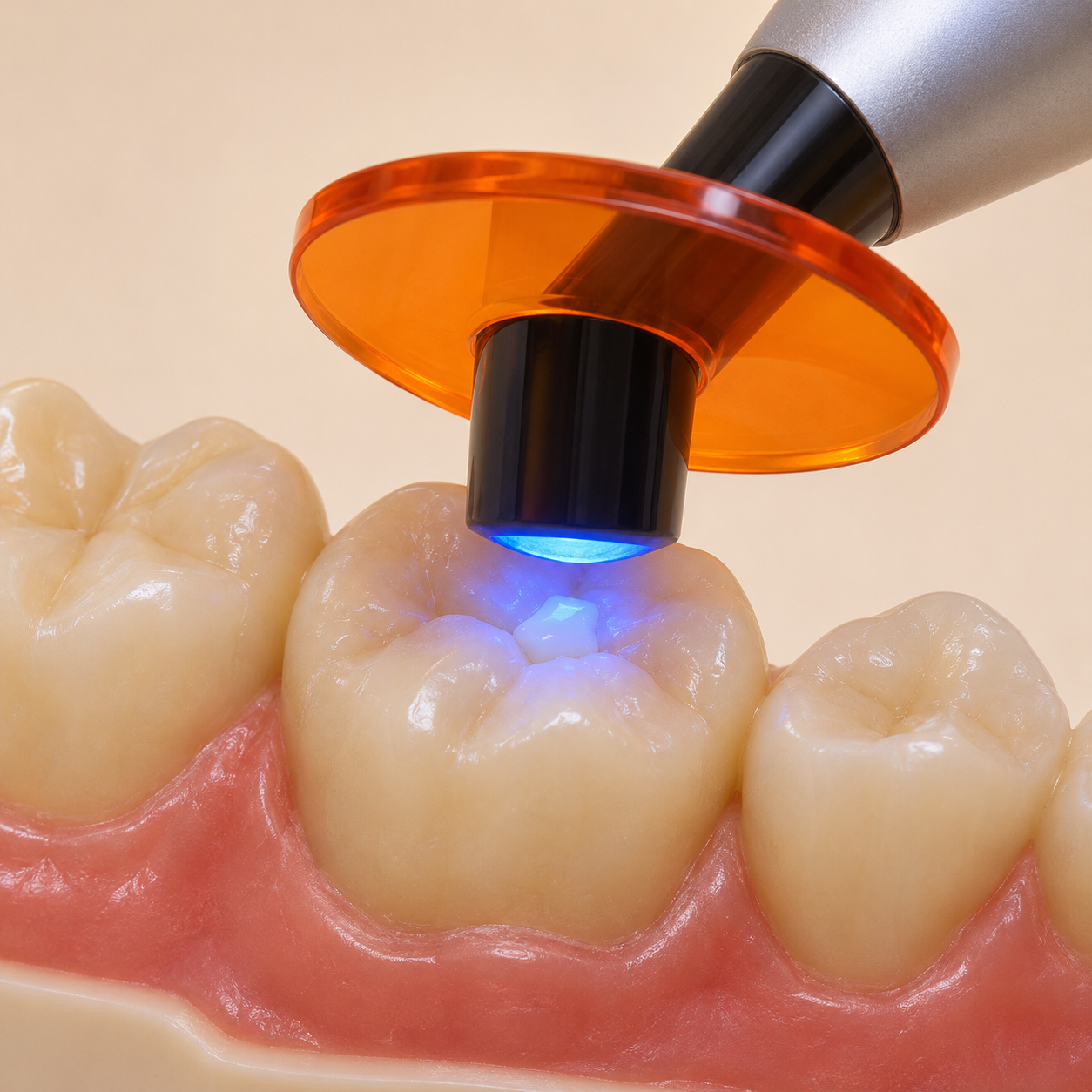
At the air interface, oxygen can interfere with the resin’s cross-linking reaction. The surface zone consequently remains less completely cured than the material beneath it.
When a composite filling is built up, fresh material is placed over an earlier layer. Interface treatment depends on the material system. Tackiness alone does not prove stronger bonding.
The final surface is finished and polished according to the material instructions; an oxygen barrier may be used. A persistently rough or sticky completed filling should be checked.
At an air-exposed resin surface during curing.
Its relevance depends on the material and processing stage.
Have the surface assessed professionally.
Three steps. No audio.
Each scene can also be selected manually.

Silent educational film with German on-screen text and simplified teaching images. Not a patient case or a promised treatment outcome. The full English explanation is available as text.
Oxygen inhibition concerns the air interface. Insufficient curing deeper within a restoration has other causes and cannot be excluded merely because the surface is smooth.
No. It arises while the resin is being processed. Plaque is an adherent microbial film; similar sensations can have different causes.
No. Laboratory studies show that interlayer bonding does not depend solely on its presence. The material, a clean interface and correct processing also matter.
No. A symptomatic filling or unusual completed surface needs dental assessment. Scraping, sanding or applying chemicals yourself can damage the restoration.
You can bring this question to your appointment:
Has the surface of my filling been fully finished, or would a check or further polishing be helpful?
An individual assessment can clarify the findings and whether referral is needed.
Arrange an assessmentAppointment selection at DoctolibOxygen inhibition concerns the air interface. Insufficient curing deeper within a restoration has other causes and cannot be excluded merely because the surface is smooth.
Editorial research: . General information, not an individual diagnosis or treatment recommendation. Teaching illustrations are simplified and do not depict a patient case.
If you turn this on, this website stores which guides you open, separately from advertising preferences. The markers expire after a fixed 30-day period from activation. The list is not sent to us by this feature. You can turn it off here and delete the markers.
Other people using the same browser profile can also see the markers. German and English versions share one marker. Expired entries are removed the next time you open a page with this feature; deleting browser data may remove them earlier. “Viewed” means opened, not read or completed.