How many teeth are missing?
At least one. The term gives no exact number.

A bounded edentulous space is a gap from one or more consecutive missing teeth with natural teeth remaining on both sides along the arch. The term describes the location. The best way to manage it depends on the wider examination.
For training & practice ↓
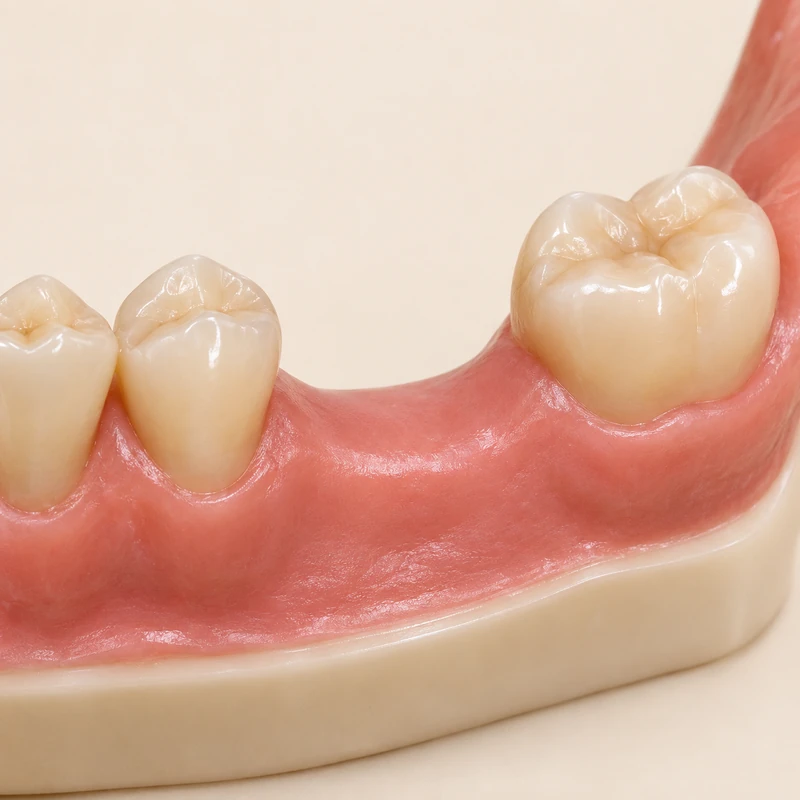
A tooth remains both in front of and behind the gap. One or several teeth can be missing between them.
A bridge supported by neighbouring teeth needs those teeth to carry the load. Their presence alone is insufficient.
An implant can replace one missing tooth independently of its neighbours. Suitability depends on individual findings.
At least one. The term gives no exact number.
The teeth remaining on either side in the same arch.
The neighbouring teeth, their supporting tissues, the opposing arch and the available width.
Three steps. No audio.
Each scene can also be selected manually.

Silent film with English on-screen text and simplified teaching images.
In a free-end situation the back teeth are missing, leaving no natural tooth behind the space. A bounded gap has that posterior boundary.
This depends on the design. Conventional bridge abutments usually need preparation. Resin-bonded bridges or implants may offer other options in suitable situations.
Yes, if natural teeth remain at both ends. The greater span changes loading and can affect the choice of restoration.
The German fixed subsidy depends on the documented overall findings and applicable rules. The term alone does not determine an amount.
When discussing a gap in the arch
How healthy are my neighbouring teeth, and which options preserve them best?
Meet Dr. Niusha Barahmand Pour ↗The gap classification describes an anatomical arrangement. It does not establish whether the bounding teeth can support a bridge.
Editorial research: . General information, not an individual diagnosis or treatment recommendation. Teaching illustrations are simplified and do not depict a patient case.
If you turn this on, this website stores which guides you open, separately from advertising preferences. The markers expire after a fixed 30-day period from activation. The list is not sent to us by this feature. You can turn it off here and delete the markers.
Other people using the same browser profile can also see the markers. German and English versions share one marker. Expired entries are removed the next time you open a page with this feature; deleting browser data may remove them earlier. “Viewed” means opened, not read or completed.