What moves?
The soft tissue over the toothless jawbone gives way under pressure.

A flabby ridge is an area of soft tissue that moves readily over a toothless segment of the jaw. It often occurs at the front of the upper jaw. A denture can rock when this tissue gives way during chewing.
For training & practice ↓
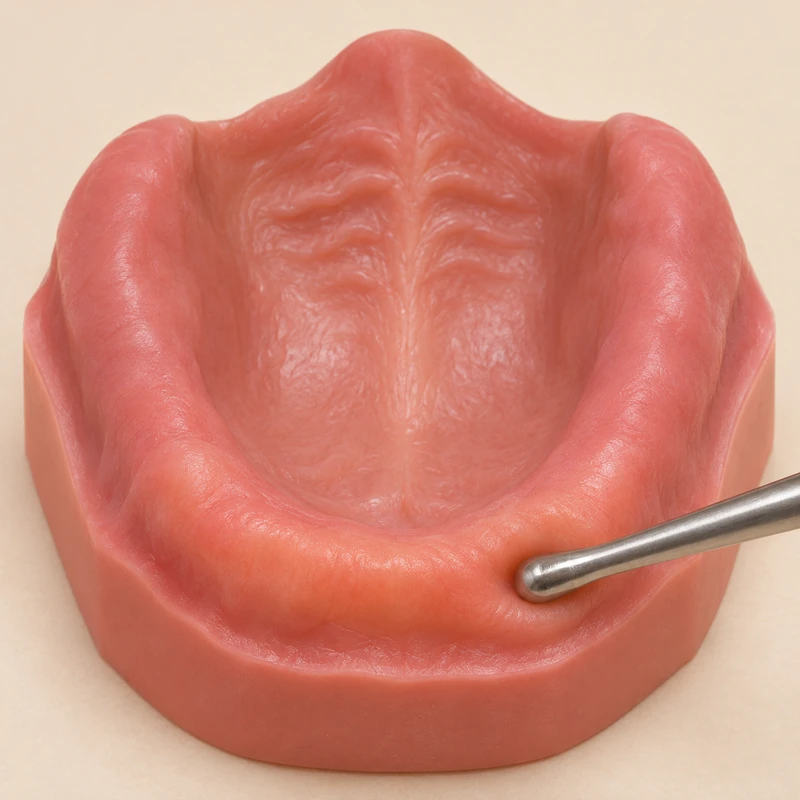
Gentle pressure displaces the soft tissue. The dentist checks where the mobile area starts and where the tissue is firmer.
An impression tray can displace the tissue. An opening allows the dentist to record the mobile area with very little pressure.
A denture can rock on a soft ridge when you bite. The dentist checks the supporting area and how the artificial teeth meet.
The soft tissue over the toothless jawbone gives way under pressure.
Tissue that has been pushed aside has a different contour at rest.
Bring your denture and show the dentist which movements make it rock or rub.
Three steps. No audio.
Each scene can also be selected manually.

Silent film with English on-screen text and simplified teaching images.
A flabby ridge describes tissue that moves easily. A sore spot is a local area of irritation from pressure. A rocking denture can draw attention to both.
Dentures can move for several reasons. The dentist examines the lining of the mouth, the fit of the base and the tooth contacts when you bite.
The tray has an opening above the mobile area. Through it the dentist can apply a thin, flowing impression material to record the tissue close to its resting shape.
Non-surgical options include an adapted impression technique for a new denture. The choice depends on the examination and how the existing denture fits.
A question to bring along
Which parts of my ridge give the denture firm support, and where does the tissue move?
Bring a denture that rocks or rubs so its fit can be assessed.
Choose an appointmentAppointment selection at DoctolibA low ridge describes reduced height. A flabby ridge describes mobility of the soft tissue. Height alone does not determine how much the tissue moves.
Editorial research: . General information, not an individual diagnosis or treatment recommendation. Teaching illustrations are simplified and do not depict a patient case.
If you turn this on, this website stores which guides you open, separately from advertising preferences. The markers expire after a fixed 30-day period from activation. The list is not sent to us by this feature. You can turn it off here and delete the markers.
Other people using the same browser profile can also see the markers. German and English versions share one marker. Expired entries are removed the next time you open a page with this feature; deleting browser data may remove them earlier. “Viewed” means opened, not read or completed.