When is shrinkage allowed for?
Before the presintered ceramic is milled.

Sintering uses heat to densify a crown or bridge milled from presintered zirconia. The piece shrinks as it densifies. Its milling dimensions allow for this change so the final shape can match the design.
For training & practice ↓
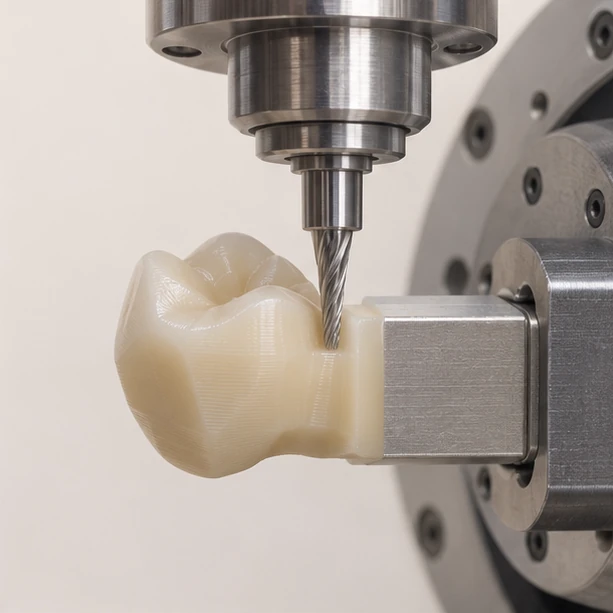
The design is enlarged for the presintered blank. The scale factor depends on the material being used.
A specified heating cycle densifies the workpiece. This produces its final dimensions and material properties.
After sintering the team checks how the restoration seats on the cast or prepared teeth. Its shape and manufacturing process can influence the result.
Before the presintered ceramic is milled.
It is part of the controlled laboratory process.
Checks include the margin and contacts.
Three steps. No audio.
Each scene can also be selected manually.

Silent film with English on-screen text and simplified teaching images.
Primarily changes the ceramic surface.
The shrinkage described here occurs during the high-temperature laboratory stage. This is complete before the crown is fitted.
The cycle depends on the material system and the restoration design. Findings for one zirconia product may have limited relevance to another.
Densification and surface finishing serve different purposes. Subsequent polishing or glazing depends on the intended restoration.
A question to bring along
How will you check the fit after laboratory fabrication?
The fit of a ceramic crown can be discussed when it is tried on the tooth.
Choose a dental appointmentAppointment selection at DoctolibDesign dimensions, milled dimensions and achieved dimensions can be compared separately.
Editorial research: . General information, not an individual diagnosis or treatment recommendation. Teaching illustrations are simplified and do not depict a patient case.
If you turn this on, this website stores which guides you open, separately from advertising preferences. The markers expire after a fixed 30-day period from activation. The list is not sent to us by this feature. You can turn it off here and delete the markers.
Other people using the same browser profile can also see the markers. German and English versions share one marker. Expired entries are removed the next time you open a page with this feature; deleting browser data may remove them earlier. “Viewed” means opened, not read or completed.