Does every salivary stone need fragmentation?
No. It may be possible to retrieve a small mobile stone in one piece. Other stones are difficult to reach. Size, site, duct access and symptoms guide the choice of procedure.

Lithotripsy means breaking a stone into smaller pieces. In a salivary duct, a specialist team can locate the stone with a fine endoscope and fragment it through a probe using mechanical pulses or laser energy. Other methods direct shock waves from outside. The choice depends on the individual findings.
For training & practice ↓
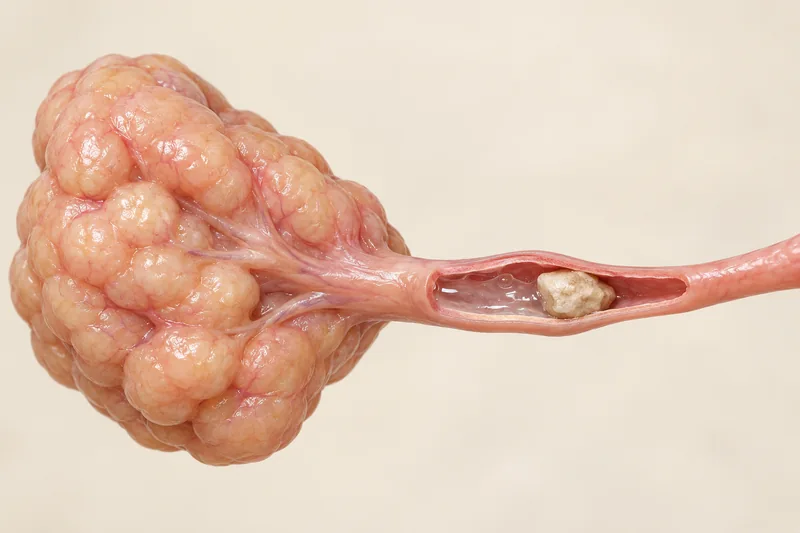
The location and size of the obstruction help determine whether it can be retrieved whole.
The cutaway model exposes a split and its fragments so the anatomy inside the duct is visible.
An endoscope allows the inside of the duct to be inspected and residual fragments to be sought and retrieved.
The location and size of the obstruction help determine whether it can be retrieved whole.
The cutaway model exposes a split and its fragments so the anatomy inside the duct is visible.
An endoscope allows the inside of the duct to be inspected and residual fragments to be sought and retrieved.
No. It may be possible to retrieve a small mobile stone in one piece. Other stones are difficult to reach. Size, site, duct access and symptoms guide the choice of procedure.
After intraductal fragmentation, instruments may be used to retrieve pieces. Small fragments can pass with the saliva. Further checks or more than one treatment session may be required.
Recurrent swelling with meals warrants ENT or maxillofacial assessment. Ultrasound can help locate the stone. Acute painful swelling with fever needs prompt medical evaluation before planning elective stone treatment.
Three steps. No audio.
Each scene can also be selected manually.

Silent film with English on-screen text and simplified teaching images.
The cutaway model exposes a split and its fragments so the anatomy inside the duct is visible.
No. It may be possible to retrieve a small mobile stone in one piece. Other stones are difficult to reach. Size, site, duct access and symptoms guide the choice of procedure.
After intraductal fragmentation, instruments may be used to retrieve pieces. Small fragments can pass with the saliva. Further checks or more than one treatment session may be required.
Recurrent swelling with meals warrants ENT or maxillofacial assessment. Ultrasound can help locate the stone. Acute painful swelling with fever needs prompt medical evaluation before planning elective stone treatment.
A question to ask
Can this stone be retrieved whole or would fragmentation help?
An ENT or maxillofacial service experienced in salivary stones can advise on treatment.
Find an ENT practice in GermanyFind a medical practice with 116117Sialendoscopy permits inspection of the duct. Lithotripsy is one possible additional intervention. Access to the stone and clearance of fragments are separate planning considerations.
Editorial research: . General information, not an individual diagnosis or treatment recommendation. Teaching illustrations are simplified and do not depict a patient case.
If you turn this on, this website stores which guides you open, separately from advertising preferences. The markers expire after a fixed 30-day period from activation. The list is not sent to us by this feature. You can turn it off here and delete the markers.
Other people using the same browser profile can also see the markers. German and English versions share one marker. Expired entries are removed the next time you open a page with this feature; deleting browser data may remove them earlier. “Viewed” means opened, not read or completed.