Is a ledge a perforation?
A shelf alone does not make an opening to the outside.

A ledge is an unintended shelf formed in the canal wall during instrumentation. An instrument can stop on the shelf even though the original canal continues beyond it.
For training & practice ↓
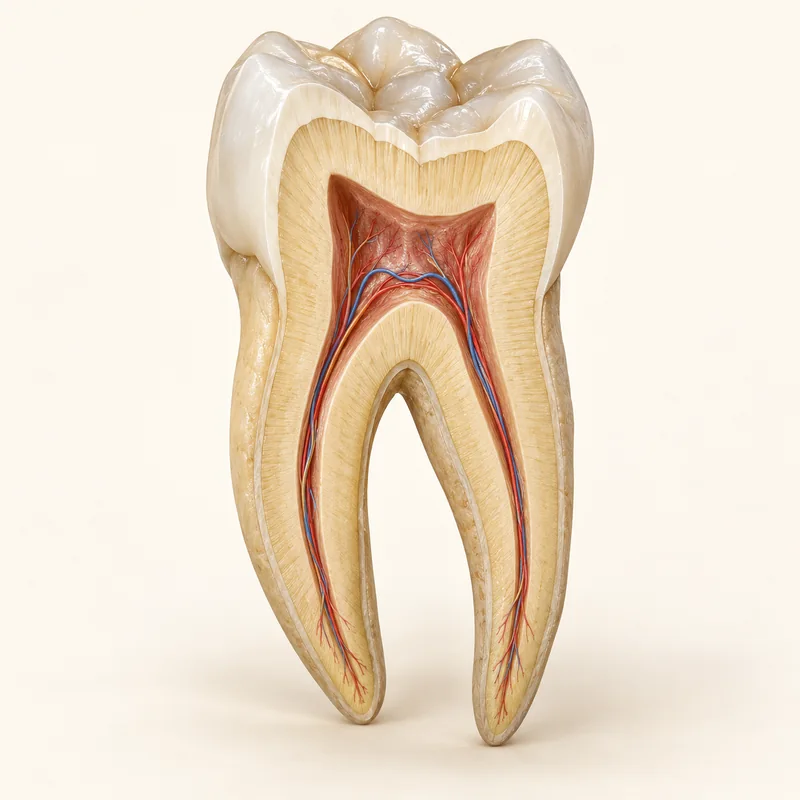
A canal can curve considerably inside a root. A ledge forms when instrumentation deviates from the original path.
The blind shelf obstructs the instrument’s path. The original canal may continue as a narrow passage beyond it.
Further planning depends on whether the original canal can be regained and the segment towards the root tip cleaned.
A shelf alone does not make an opening to the outside.
A sharply curved canal can be challenging to follow.
Access to the original canal and the overall condition of the tooth.
Three steps. No audio.
Each scene can also be selected manually.

Silent film with English on-screen text and simplified teaching images.
A fractured instrument can leave a fragment in the canal. A ledge is a change in the shape of the tooth structure.
A ledge lies in the wall inside the root. A perforation creates a connection with tissue outside the tooth.
In a tight curve an instrument may change the path along the outer wall. A study of instrumented canals found a clear association with curvature.
This depends on the accessible canal, infection and whether the tooth can be restored. Difficult anatomy may warrant an endodontic opinion.
A question to bring along
Can the segment beyond the ledge be reached for cleaning and filling?
Radiographs and treatment records can help you discuss further access to the canal.
Choose an appointmentAppointment selection at DoctolibRates observed in training and specialist settings cannot be applied to every individual tooth.
Editorial research: . General information, not an individual diagnosis or treatment recommendation. Teaching illustrations are simplified and do not depict a patient case.
If you turn this on, this website stores which guides you open, separately from advertising preferences. The markers expire after a fixed 30-day period from activation. The list is not sent to us by this feature. You can turn it off here and delete the markers.
Other people using the same browser profile can also see the markers. German and English versions share one marker. Expired entries are removed the next time you open a page with this feature; deleting browser data may remove them earlier. “Viewed” means opened, not read or completed.