Memory test?
No.

In teach-back, a person describes important information in their own words. This helps both parties check whether an explanation was clear and identify unanswered questions. It is not a test of knowledge or intelligence. Dental examples include understanding an oral care plan or the next treatment steps.
For training & practice ↓
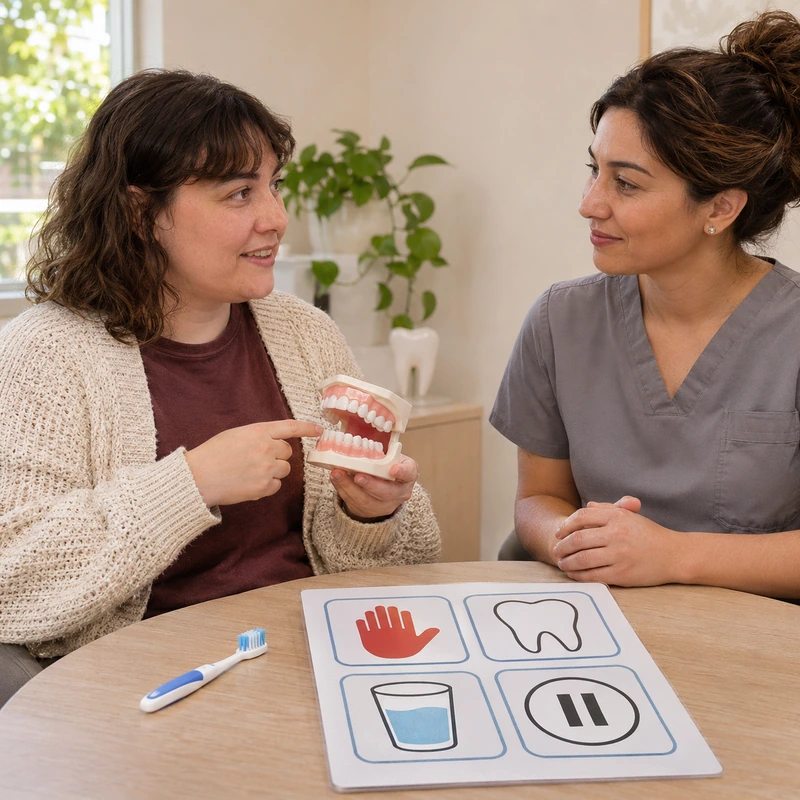
First discuss one specific piece of information in clear language. Do not assume someone can absorb many new tasks as one long block.
An example question is: How would you describe the agreed next step at home? Demonstrating a practical task can also help.
If the response does not match the explanation, explain differently and discuss it again. Responsibility for clarity does not rest only with the listener.
No.
Yes.
Absolutely.
Three steps. No audio.
Each scene can also be selected manually.

Silent educational film with German on-screen text and simplified teaching images. Not a patient case or a promised treatment outcome. The full English explanation is available as text.
Teach-back checks understanding through feedback. Tell-show-do prepares a procedure through explanation and demonstration.
Someone can easily say yes while remaining uncertain. Their own description reveals specific questions.
No. Your own words are encouraged. Reciting terminology does not necessarily show understanding.
Yes. This is not a memory test. Helpful written information can support understanding of the main points.
Feedback should fit the person’s communication method, such as pictures, writing or demonstration. Speaking aloud is not a prerequisite for good communication.
No. Understanding something does not mean agreeing to it. Preferences and any required consent need separate discussion.
You can bring this question to your appointment:
Can I briefly explain in my own words what is planned next?
Write down unclear terms or steps and bring them to the discussion.
Discuss dental careAppointment selection at DoctolibTeach-back checks understanding through feedback. Tell-show-do prepares a procedure through explanation and demonstration.
Editorial research: . General information, not an individual diagnosis or treatment recommendation. Teaching illustrations are simplified and do not depict a patient case.
If you turn this on, this website stores which guides you open, separately from advertising preferences. The markers expire after a fixed 30-day period from activation. The list is not sent to us by this feature. You can turn it off here and delete the markers.
Other people using the same browser profile can also see the markers. German and English versions share one marker. Expired entries are removed the next time you open a page with this feature; deleting browser data may remove them earlier. “Viewed” means opened, not read or completed.