Only the crown?
Root position also matters.

In orthodontics, torque refers to control of tooth inclination towards the lip, cheek or tongue. The position of the root within the surrounding bone is particularly relevant. A straight-looking crown alone does not show the whole tooth’s position in three dimensions.
For training & practice ↓
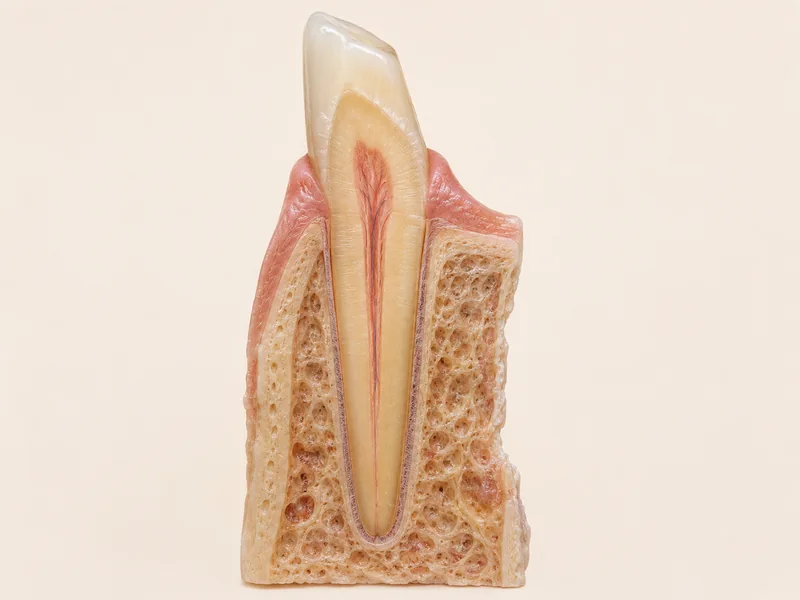
The visible part of a tooth does not fully reveal its root position. Planning considers the crown, root and surrounding tissues together; the crown and root remain one rigid unit.
A suitable force system can create a moment. In fixed appliances, the archwire and bracket are among the relevant components.
Root position, bone and supporting tissues must be considered. A schematic movement does not predict an individual treatment course.
Root position also matters.
Planning depends on the findings.
No; the diagram explains a principle.
Three steps. No audio.
Each scene can also be selected manually.

Silent educational film with German on-screen text and simplified teaching images. Not a patient case or a promised treatment outcome. The full English explanation is available as text.
Torque mainly concerns inclination towards the lip or tongue. Rotation describes turning around the tooth’s long axis. Both can be involved in treatment.
The term concerns a moment or control of inclination. A single force may also translate or tip a tooth; the complete force system matters.
Not reliably. The visible crown does not fully reveal root position. Examination determines whether additional diagnostic records are needed.
No. The planned amount must suit the tooth, bone and bite. A larger movement is not a general measure of quality.
You can bring this question to your appointment:
What tooth inclination is appropriate in my case, and how is root position considered?
An examination can clarify the finding and any need for referral.
Arrange an assessmentAppointment selection at DoctolibTorque mainly concerns inclination towards the lip or tongue. Rotation describes turning around the tooth’s long axis. Both can be involved in treatment.
Editorial research: . General information, not an individual diagnosis or treatment recommendation. Teaching illustrations are simplified and do not depict a patient case.