What should I check on the packaging?
Look for a fluoride ingredient and a stated concentration. If you switch away from fluoride toothpaste, discuss how you will maintain protection against decay.

Tooth powder is a dry cleaning product used on a toothbrush. Brushing with it can remove plaque. Its contribution to decay prevention depends in part on whether it supplies fluoride. The colour of the powder tells you neither its fluoride content nor how abrasive it is.
For training & practice ↓
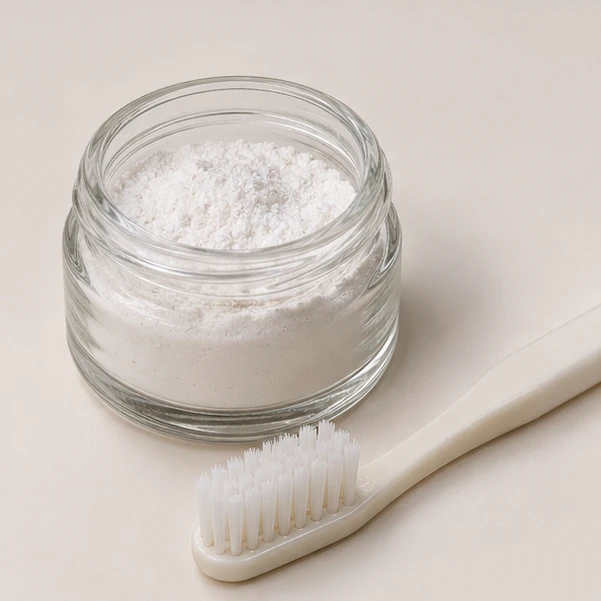
Tooth powder is used with a brush. Colour alone does not reveal the fluoride content.
A plaque score measures deposits present now. It cannot establish how many cavities will develop over years.
Compare the active ingredient, concentration and intended use as well as the product form.
Tooth powder is used with a brush. Colour alone does not reveal the fluoride content.
A plaque score measures deposits present now. It cannot establish how many cavities will develop over years.
Compare the active ingredient, concentration and intended use as well as the product form.
Look for a fluoride ingredient and a stated concentration. If you switch away from fluoride toothpaste, discuss how you will maintain protection against decay.
A trial with 89 young adults found no clear difference in plaque after seven days with one powder versus one paste. It did not track new cavities for years or test every product.
Particle properties and formulations vary. If you have exposed or sensitive tooth necks, discuss brushing pressure and product choice rather than relying on a natural-product claim.
Three steps. No audio.
Each scene can also be selected manually.

Silent film with English on-screen text and simplified teaching images.
Powder or paste describes the form. Fluoride and how the product is used matter for decay prevention.
Look for a fluoride ingredient and a stated concentration. If you switch away from fluoride toothpaste, discuss how you will maintain protection against decay.
A trial with 89 young adults found no clear difference in plaque after seven days with one powder versus one paste. It did not track new cavities for years or test every product.
Particle properties and formulations vary. If you have exposed or sensitive tooth necks, discuss brushing pressure and product choice rather than relying on a natural-product claim.
A question to ask
Does this powder provide appropriate fluoride for my daily routine?
Bring the product to a check-up if you would like help interpreting its label.
Choose an appointmentAppointment selection at DoctolibPlaque removal, abrasion and decay prevention are separate outcomes. A short-term change in a plaque score addresses only the first.
Editorial research: . General information, not an individual diagnosis or treatment recommendation. Teaching illustrations are simplified and do not depict a patient case.
If you turn this on, this website stores which guides you open, separately from advertising preferences. The markers expire after a fixed 30-day period from activation. The list is not sent to us by this feature. You can turn it off here and delete the markers.
Other people using the same browser profile can also see the markers. German and English versions share one marker. Expired entries are removed the next time you open a page with this feature; deleting browser data may remove them earlier. “Viewed” means opened, not read or completed.