Should I push if the stick feels tight?
Avoid forcing the stick across the gum tip. Ask about a suitable size or floss for a tight contact. A correctly sized interdental brush is often recommended for wider gaps.

A wooden interdental cleaner is a small stick, often triangular, for accessible gaps between teeth. Its shape and width need to fit the space. Other aids may reach the sides of the teeth more effectively in very tight or wider gaps.
For training & practice ↓
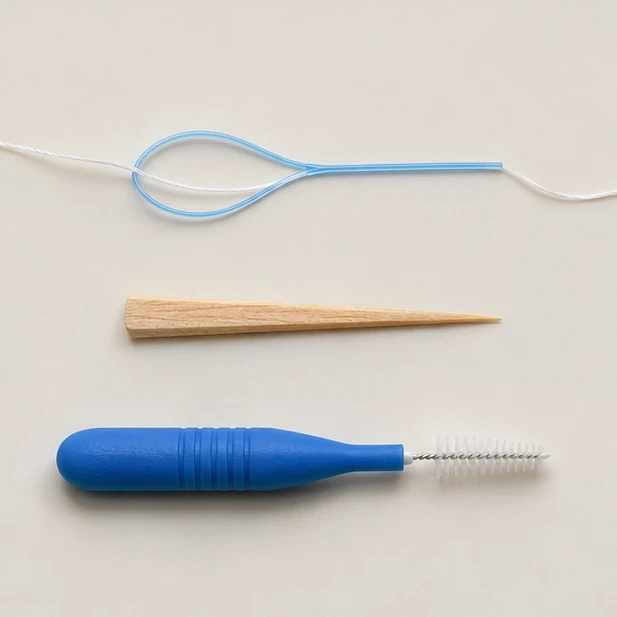
The wooden stick in the middle is for mechanical cleaning of a suitably sized space.
The bristles of a correctly sized brush contact the sides of the teeth.
Floss may suit a tight contact. Access to the side surface matters.
The wooden stick in the middle is for mechanical cleaning of a suitably sized space.
The bristles of a correctly sized brush contact the sides of the teeth.
Floss may suit a tight contact. Access to the side surface matters.
Avoid forcing the stick across the gum tip. Ask about a suitable size or floss for a tight contact. A correctly sized interdental brush is often recommended for wider gaps.
Visible food may come out quickly. Plaque also adheres to the side surfaces. A suitable aid should gently contact and clean those surfaces.
A small study of 15 people compared triangular sticks with round toothpicks. Both reduced the plaque measured immediately after use. This does not establish long-term decay prevention or a single best shape for every gap.
Three steps. No audio.
Each scene can also be selected manually.

Silent film with English on-screen text and simplified teaching images.
Dislodging a piece of food and removing adherent plaque from the side surfaces are different tasks.
Avoid forcing the stick across the gum tip. Ask about a suitable size or floss for a tight contact. A correctly sized interdental brush is often recommended for wider gaps.
Visible food may come out quickly. Plaque also adheres to the side surfaces. A suitable aid should gently contact and clean those surfaces.
A small study of 15 people compared triangular sticks with round toothpicks. Both reduced the plaque measured immediately after use. This does not establish long-term decay prevention or a single best shape for every gap.
A question to ask
Which spaces suit a wooden stick and where would a brush fit better?
Recurring bleeding or painful gaps warrant a check of the gums and the fit of your cleaning aid.
Choose an appointmentAppointment selection at DoctolibSpaces near the gumline differ in cross section. Assess the fit separately at each site.
Editorial research: . General information, not an individual diagnosis or treatment recommendation. Teaching illustrations are simplified and do not depict a patient case.
If you turn this on, this website stores which guides you open, separately from advertising preferences. The markers expire after a fixed 30-day period from activation. The list is not sent to us by this feature. You can turn it off here and delete the markers.
Other people using the same browser profile can also see the markers. German and English versions share one marker. Expired entries are removed the next time you open a page with this feature; deleting browser data may remove them earlier. “Viewed” means opened, not read or completed.