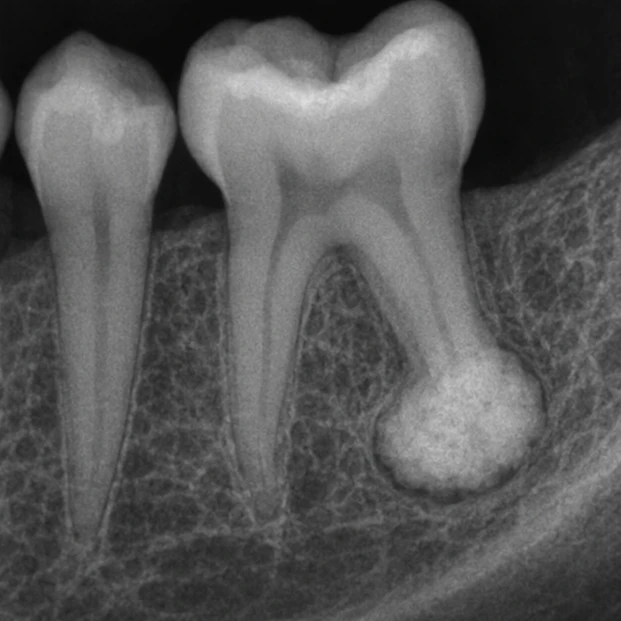
What is a mineralised growth attached to a tooth root?
A cementoblastoma is a rare benign tumour that forms cementum-like hard tissue attached to a tooth root. A lower back tooth is often involved. An X-ray may show a rounded radiopaque mass fused to the root and surrounded by a thin darker rim.
Is every white spot beside a root a cementoblastoma?
No. The root outline can often be traced separately in other dense areas. Attachment to the root, the margins and the course help guide assessment. A specialist interprets the imaging alongside tissue findings where appropriate.
02
Can the involved tooth still respond to cold?
Yes. The growth arises at the root surface. A response to a pulp sensibility test does not exclude it. Testing neighbouring teeth can help narrow other causes.
03
Why investigate a benign tumour further?
A cementoblastoma can grow and expand the jawbone. An oral and maxillofacial specialist plans management. Follow-up after removal matters because the growth can recur.
Knowledge in motion
Explained in 36 seconds.
Three steps. No audio. Each scene can also be selected manually.
Silent film with English on-screen text and simplified teaching images.
In the comparison, the opacity is separate from the adjacent roots.
Quick answersIs every white spot beside a root a cementoblastoma?
No. The root outline can often be traced separately in other dense areas. Attachment to the root, the margins and the course help guide assessment. A specialist interprets the imaging alongside tissue findings where appropriate.
Can the involved tooth still respond to cold?
Yes. The growth arises at the root surface. A response to a pulp sensibility test does not exclude it. Testing neighbouring teeth can help narrow other causes.
Why investigate a benign tumour further?
A cementoblastoma can grow and expand the jawbone. An oral and maxillofacial specialist plans management. Follow-up after removal matters because the growth can recur.
At the practice
At the examination
A question to ask
How can you tell whether the opacity attaches to the root?
An unexplained root-attached finding merits dental and, if indicated, maxillofacial assessment.
Editorial research: . General information, not an individual diagnosis or treatment recommendation. Teaching illustrations are simplified and do not depict a patient case.
If you turn this on, this website stores which guides you open, separately from advertising preferences. The markers expire after a fixed 30-day period from activation. The list is not sent to us by this feature. You can turn it off here and delete the markers.
Other people using the same browser profile can also see the markers. German and English versions share one marker. Expired entries are removed the next time you open a page with this feature; deleting browser data may remove them earlier. “Viewed” means opened, not read or completed.
With your consent, we use Google Ads to attribute clicks on our appointment booking links and phone number to adverts. Google processes technical usage data and sets or reads cookies. Data may be processed in the USA. Advertising measurement does not load without your consent. Google Analytics and personalised advertising are not enabled. Google Maps loads separately when you choose to open the map. You can change your choice here at any time.