Where can remnants remain?
At the crown margin, including beneath the gums.

Cement remnants can remain at the margin of a cement-retained implant crown, including below the gumline. Such excess cement may be associated with inflammation of nearby tissues. However, cement does not cause every case of inflammation around an implant.
For training & practice ↓
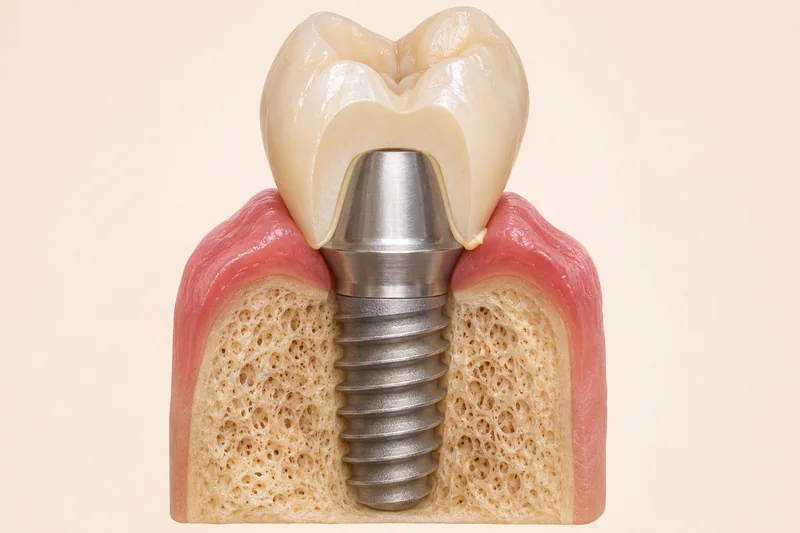
In a cement-retained restoration, cement attaches the crown to the implant abutment. This is separate from anchoring the implant body in bone.
If a margin lies beneath the gums, remnants may be difficult to access. They are not always visible from outside; an image or symptom alone cannot prove they are present.
Signs of inflammation call for examination of the restoration and surrounding tissues. When professional removal of remnants is needed, the tissues are reassessed afterwards.
At the crown margin, including beneath the gums.
With bleeding, swelling, discomfort or changes in the restoration.
Examination, any necessary professional correction and follow-up.
Three steps. No audio.
Each scene can also be selected manually.

Silent educational film with German on-screen text and simplified teaching images. Not a patient case or a promised treatment outcome. The full English explanation is available as text.
Luting cement is a dental material. Calculus consists of mineralised deposits. Distinguishing and removing these requires professional care.
No. Screw-retained designs also exist. The attachment method cannot reliably be identified from the visible crown alone.
No. Bleeding can have several causes. Examination considers deposits, tissues, restoration design and possible hidden cement remnants.
No. The extent and causes of inflammation and any bone loss guide further care. Follow-up remains important.
You can bring this question to your appointment:
Is my crown cement retained, and could hidden cement contribute to the inflammation?
An examination can clarify the finding and any need for referral.
Arrange an assessmentAppointment selection at DoctolibLuting cement is a dental material. Calculus consists of mineralised deposits. Distinguishing and removing these requires professional care.
Editorial research: . General information, not an individual diagnosis or treatment recommendation. Teaching illustrations are simplified and do not depict a patient case.