Independent of what?
The definition of tooth contacts.

Centric relation is a defined relationship between the lower and upper jaws that is described independently of tooth contacts. Prosthodontics uses it as a joint-related reference intended to be reproducible for assessment and planning. It is not automatically identical to the habitual position of maximum tooth fit, and it does not mean pushing the lower jaw as far backwards as possible.
For training & practice ↓
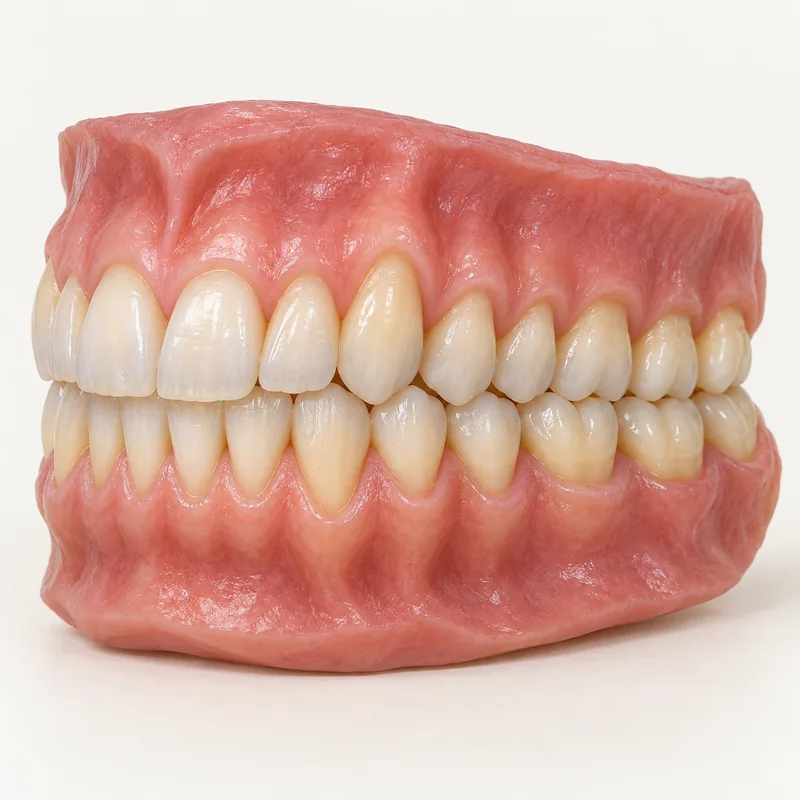
Centric relation describes the jaw relationship with reference to the joints. Its definition does not depend on which teeth happen to be touching.
Maximum intercuspation is determined by the tooth surfaces. It may coincide with contacts in centric relation, but it does not have to.
A record should be reproducible enough for its planning purpose. A difference from the habitual bite alone proves neither disease nor the need for correction.
The definition of tooth contacts.
Not necessarily.
No; it is a defined reference.
Three steps. No audio.
Each scene can also be selected manually.

Silent educational film with German on-screen text and simplified teaching images. Not a patient case or a promised treatment outcome. The full English explanation is available as text.
Centric relation describes the jaw relationship independently of tooth contacts. Centric occlusion describes the contacts occurring when the jaws are in that relationship.
No. Maximum intercuspation is determined by the teeth. Centric relation is defined independently of that position.
No. The current technical definition describes a joint-related position with the condyles anteriorly and superiorly against the posterior slopes of the articular eminences. It is not an instruction to push the jaw backwards.
In assessment and prosthodontic planning, a defined jaw relationship can help relate findings and casts, including situations where existing tooth contacts are insufficient for that purpose.
No. Differences also occur in natural dentitions. Symptoms, function and other findings require separate assessment.
Not simply because of the term. Forcing your jaw into a position is not a measurement. Permanent changes to tooth surfaces need a specific indication and are not a general treatment for TMD.
You can bring this question to your appointment:
Which jaw relationship is being recorded for my treatment, and what would a difference from my habitual bite mean?
A dental examination can clarify how this relates to your findings and treatment planning.
Discuss your dental findingsAppointment selection at DoctolibCentric relation describes the jaw relationship independently of tooth contacts. Centric occlusion describes the contacts occurring when the jaws are in that relationship.
Editorial research: . General information, not an individual diagnosis or treatment recommendation. Teaching illustrations are simplified and do not depict a patient case.
If you turn this on, this website stores which guides you open, separately from advertising preferences. The markers expire after a fixed 30-day period from activation. The list is not sent to us by this feature. You can turn it off here and delete the markers.
Other people using the same browser profile can also see the markers. German and English versions share one marker. Expired entries are removed the next time you open a page with this feature; deleting browser data may remove them earlier. “Viewed” means opened, not read or completed.