What does “cancer at the back of the tongue” mean?
The site matters. Cancer arising in the back third, the tongue base, is an oropharyngeal cancer.

It is usually a squamous cell carcinoma arising in the front two-thirds of the tongue. A persistent sore or firm area can develop along one side. A sharp tooth can also cause soreness there. Appearance and the amount of pain alone do not distinguish between these causes.
For training & practice ↓
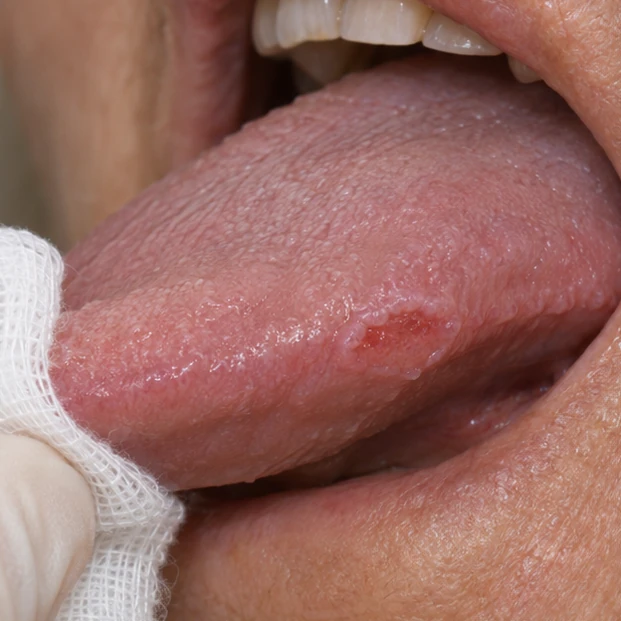
The lateral border belongs to the mobile tongue. A persistent sore here deserves examination. This illustration alone cannot diagnose cancer.
Assessment covers the rest of the oral lining and the neck as well as the visible spot. Tell the clinician how long it has been present.
Examining a tissue sample under the microscope can identify the cells in a suspicious lesion.
The site matters. Cancer arising in the back third, the tongue base, is an oropharyngeal cancer.
Arrange prompt examination for a new firm lump, spontaneous bleeding or reduced tongue movement.
A dentist, ENT clinician or oral and maxillofacial specialist can examine the area and arrange referral where appropriate.
Three steps. No audio.
Each scene can also be selected manually.

Silent film with English on-screen text and simplified teaching images.
Assessment covers the rest of the oral lining and the neck as well as the visible spot. Tell the clinician how long it has been present.
The site matters. Cancer arising in the back third, the tongue base, is an oropharyngeal cancer. A cancer of the mobile tongue belongs to the oral cavity. Assessment and treatment planning differ between these areas, so the medical report should name the precise site. Oral cavity cancer
Arrange prompt examination for a new firm lump, spontaneous bleeding or reduced tongue movement. German guidance calls for prompt specialist assessment of an unexplained change in the lining of the mouth that persists for more than two weeks. This also applies when a denture or a sharp edge could be irritating the same spot.
A dentist, ENT clinician or oral and maxillofacial specialist can examine the area and arrange referral where appropriate. A suspicious lesion is assessed by biopsy. If cancer is confirmed, the specialist team assesses its depth of invasion and the lymph nodes in the neck, among other factors. Leukoplakia
A question to ask
Does this area on the side of my tongue need specialist assessment or a biopsy?
Arrange prompt dental, ENT or maxillofacial assessment for a new firm lump or persistent sore on the side of the tongue.
Choose an appointmentAppointment selection at DoctolibInspect both lateral borders and the underside of the tongue. Record the duration, palpable firmness and exact location. Microscopic diagnosis and assessment of disease extent address different questions.
Editorial research: . General information, not an individual diagnosis or treatment recommendation. Teaching illustrations are simplified and do not depict a patient case.
If you turn this on, this website stores which guides you open, separately from advertising preferences. The markers expire after a fixed 30-day period from activation. The list is not sent to us by this feature. You can turn it off here and delete the markers.
Other people using the same browser profile can also see the markers. German and English versions share one marker. Expired entries are removed the next time you open a page with this feature; deleting browser data may remove them earlier. “Viewed” means opened, not read or completed.