Which discolouration can cleaning address?
Primarily external stains on the tooth surface.

Charcoal toothpaste contains fine carbon particles and is often marketed for whitening. Evidence has not established a reliable additional whitening benefit with adequate safety. For daily use, the complete formulation, its abrasiveness and its fluoride content matter.
For training & practice ↓
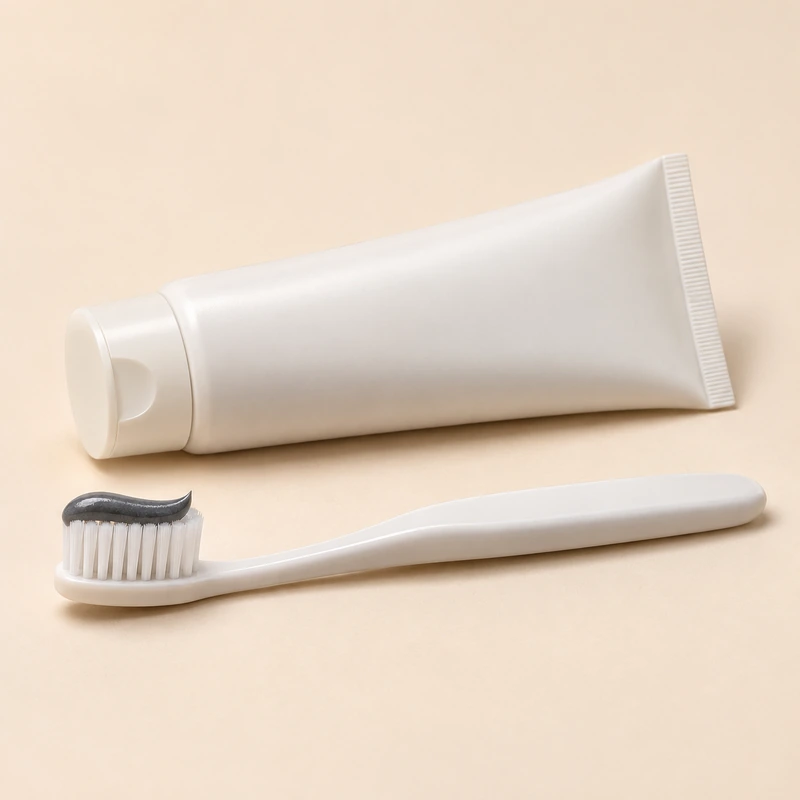
Abrasives can remove external stains. This cleaning effect does not change the underlying tooth shade in the way chemical bleaching can.
The colour alone cannot establish whether every formulation is harmful. Abrasion depends on the product and its use. Scrubbing harder is not a useful way to whiten teeth.
A charcoal claim does not tell you the fluoride content. For decay prevention, look for fluoride and its stated concentration.
Primarily external stains on the tooth surface.
No. Formulations and abrasiveness differ, and safety as a whitening method is inadequately established.
No. Fluoride protection depends on fluoride in the formulation.
Three steps. No audio.
Each scene can also be selected manually.

Silent educational film with German on-screen text and simplified teaching images. Not a patient case or a promised treatment outcome. The full English explanation is available as text.
Fluoride helps prevent decay. That fact does not establish a separate claim that the product offers safe additional whitening.
Abrasives can remove external stains. This cleaning effect does not change the underlying tooth shade in the way chemical bleaching can.
The colour alone cannot establish whether every formulation is harmful. Abrasion depends on the product and its use. Scrubbing harder is not a useful way to whiten teeth.
A charcoal claim does not tell you the fluoride content. For decay prevention, look for fluoride and its stated concentration.
It provides no fluoride for decay prevention during brushing. Charcoal cannot substitute for the action of fluoride toothpaste.
Fluoride helps prevent decay. That fact does not establish a separate claim that the product offers safe additional whitening.
A question you could ask
Are my concerns about surface stains or underlying tooth shade, and what care suits that?
Bring the product details to your appointment if you have questions about abrasion or fluoride content.
Discuss at a dental appointmentAppointment selection at DoctolibFluoride helps prevent decay. That fact does not establish a separate claim that the product offers safe additional whitening.
Editorial research: . General information, not an individual diagnosis or treatment recommendation. Teaching illustrations are simplified and do not depict a patient case.
If you turn this on, this website stores which guides you open, separately from advertising preferences. The markers expire after a fixed 30-day period from activation. The list is not sent to us by this feature. You can turn it off here and delete the markers.
Other people using the same browser profile can also see the markers. German and English versions share one marker. Expired entries are removed the next time you open a page with this feature; deleting browser data may remove them earlier. “Viewed” means opened, not read or completed.