Is every open root tip a sign of disease?
No. It may be normal in an immature permanent tooth. Developmental stage and any signs of disease or injury matter.

Apexogenesis is the continued natural development of the root of an immature permanent tooth with living pulp tissue. The root can lengthen, its walls can thicken and its initially wide opening can close.
For training & practice ↓
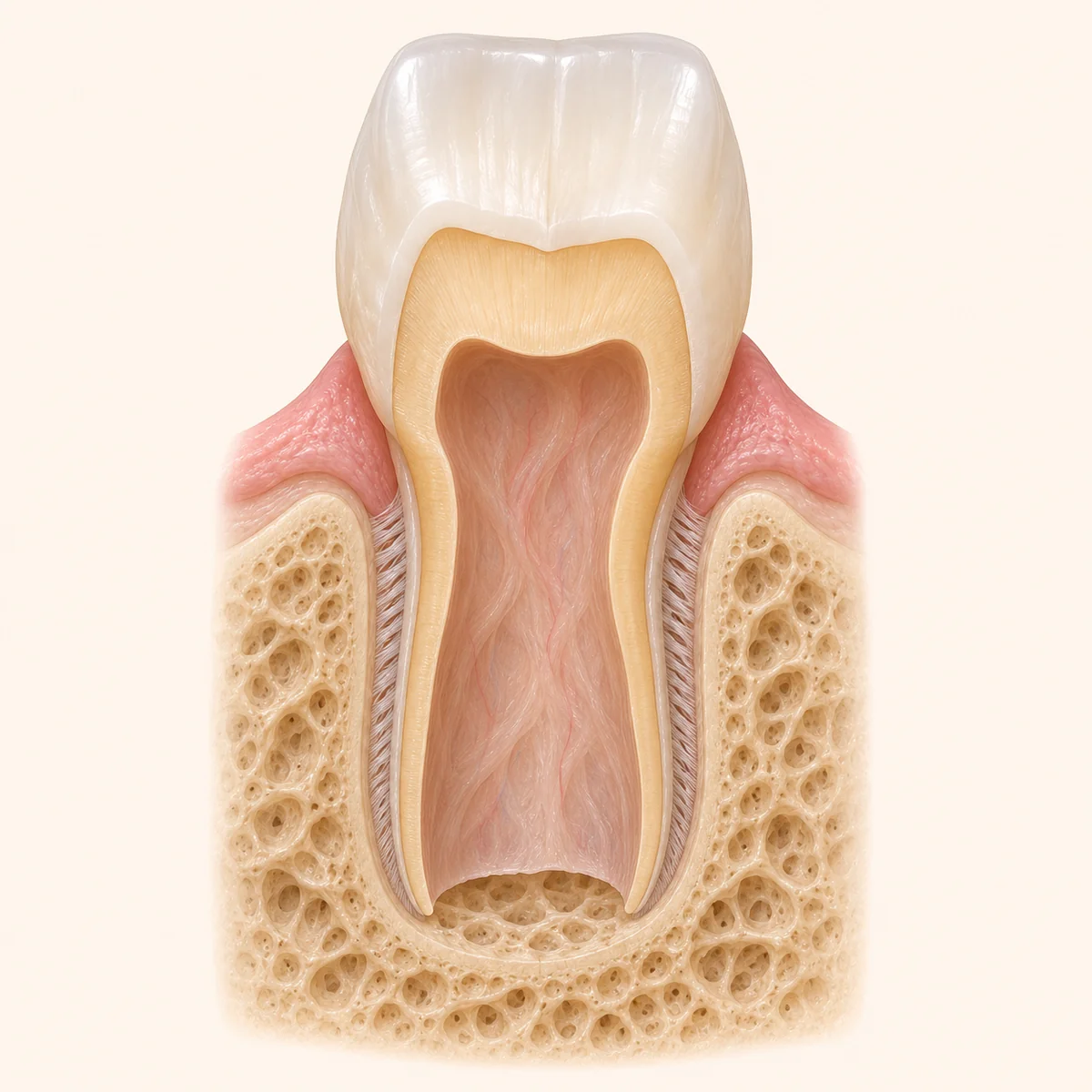
An erupted permanent tooth can still have a short root with thin walls and a wide opening. This appearance can be part of normal development in a young tooth.
Following injury or deep decay, the team checks whether living pulp can be preserved. Different forms of vital pulp treatment may be appropriate depending on the findings.
Follow-up images allow comparison of root length, wall thickness and tip shape over time. Symptoms and clinical findings also inform the assessment.
No. It may be normal in an immature permanent tooth. Developmental stage and any signs of disease or injury matter.
It describes continued root development.
In suitable cases enough vital root pulp may remain after an injured or inflamed coronal portion has been removed.
Three steps. No audio.
Each scene can also be selected manually.

Silent educational film with German on-screen text and simplified teaching images. Not a patient case or a promised treatment outcome. The full English explanation is available as text.
Apexogenesis relies on vital tissue for natural development. Apexification aims at a barrier at the open end of a non-vital immature tooth.
No. It may be normal in an immature permanent tooth. Developmental stage and any signs of disease or injury matter.
It describes continued root development. Treatment to preserve the pulp can create the conditions for that development.
In suitable cases enough vital root pulp may remain after an injured or inflamed coronal portion has been removed.
An immature tooth with necrotic pulp needs assessment for other approaches such as apexification or regenerative endodontics. The starting conditions are different.
A question you could ask
What will show whether my child's root is still developing?
What will show whether my child's root is still developing?
Arrange a dental consultationAppointment selection at DoctolibApexogenesis relies on vital tissue for natural development. Apexification aims at a barrier at the open end of a non-vital immature tooth.
Editorial research: . General information, not an individual diagnosis or treatment recommendation. Teaching illustrations are simplified and do not depict a patient case.
If you turn this on, this website stores which guides you open, separately from advertising preferences. The markers expire after a fixed 30-day period from activation. The list is not sent to us by this feature. You can turn it off here and delete the markers.
Other people using the same browser profile can also see the markers. German and English versions share one marker. Expired entries are removed the next time you open a page with this feature; deleting browser data may remove them earlier. “Viewed” means opened, not read or completed.