Marks on the chewing surface
The small blue marks show where paper contacted the chewing surface.

Articulating paper leaves coloured marks where the teeth touch the strip on closing or moving the jaw. The dentist can see which part of a new filling meets the opposing tooth.
For training & practice ↓
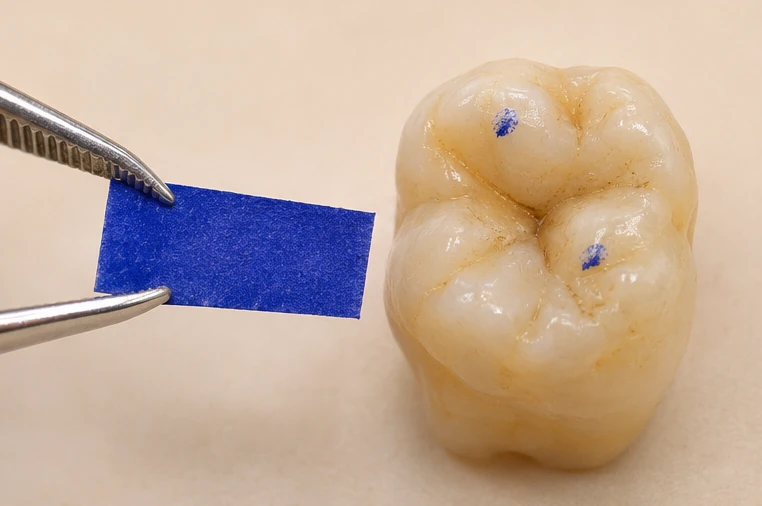
The small blue marks show where paper contacted the chewing surface.
Closing and sliding sideways bring the teeth into different positions.
A digital contact map uses a different measurement principle from a paper mark.
The small blue marks show where paper contacted the chewing surface.
Closing and sliding sideways bring the teeth into different positions.
A digital contact map uses a different measurement principle from a paper mark.
The small blue marks show where paper contacted the chewing surface.
Closing and sliding sideways bring the teeth into different positions.
A digital contact map uses a different measurement principle from a paper mark.
Three steps. No audio.
Each scene can also be selected manually.

Silent film with English on-screen text and simplified teaching images.
Mark size or darkness alone cannot reliably tell how heavily that point is loaded. The contact pattern, examination and what you feel when biting are considered together.
Mark size or darkness alone cannot reliably tell how heavily that point is loaded. The contact pattern, examination and what you feel when biting are considered together.
Contacts on closing can differ from those during a sideways movement. A streak helps show where the new restoration touches as the teeth slide.
If one tooth meets first or biting discomfort persists after the appointment, contact the dental team. Say whether it occurs on closing or during a particular movement.
A question to ask
Can you check the tooth on closing and during the movement in which it feels high?
Choose an appointment to discuss your own tooth or restoration.
Choose an appointmentAppointment selection at DoctolibA mark records the position of contact under the conditions of the test. A static contact mark and a sliding trace give different information.
Editorial research: . General information, not an individual diagnosis or treatment recommendation. Teaching illustrations are simplified and do not depict a patient case.
If you turn this on, this website stores which guides you open, separately from advertising preferences. The markers expire after a fixed 30-day period from activation. The list is not sent to us by this feature. You can turn it off here and delete the markers.
Other people using the same browser profile can also see the markers. German and English versions share one marker. Expired entries are removed the next time you open a page with this feature; deleting browser data may remove them earlier. “Viewed” means opened, not read or completed.