Is it a disease?
No, it is an anatomical variation.

A C-shaped root canal is a variation in a tooth’s internal anatomy. In cross-section, narrow connections between canal areas create a C-like arrangement at some levels. The shape may change along the root. It is not itself a disease, but can make necessary root canal treatment more demanding.
For training & practice ↓
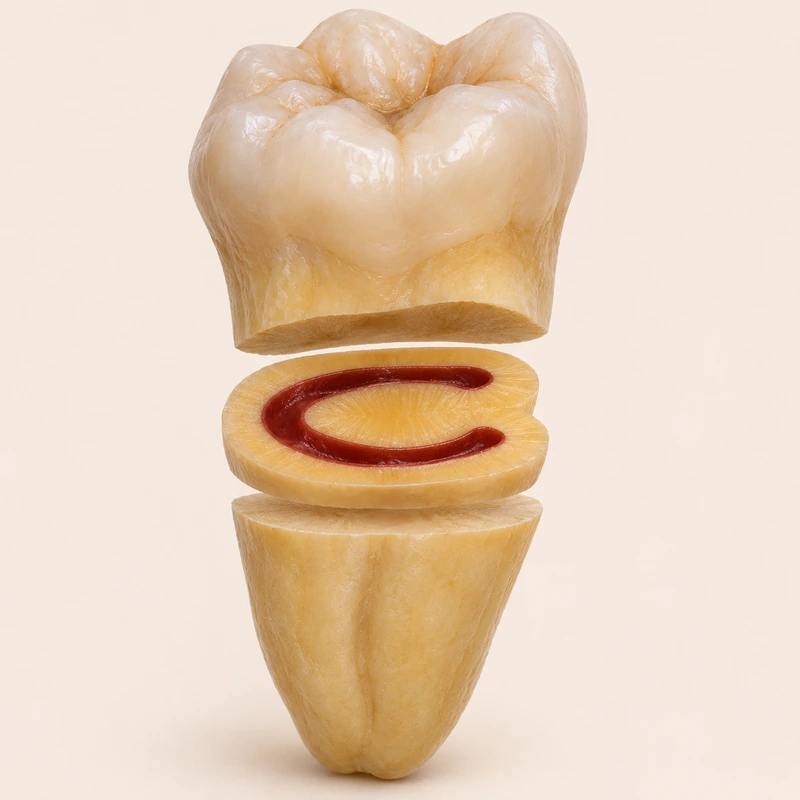
The C describes a view across the root. It does not simply mean that a canal curves along its length.
Thin connections between canal spaces may be difficult for instruments to reach. Cleaning and irrigation take this anatomy into account.
One slice does not show the whole canal system. Clinical findings, magnification and further imaging when justified help guide treatment planning.
No, it is an anatomical variation.
Narrow connections and changing canal shapes.
No. Different root levels can look different.
Three steps. No audio.
Each scene can also be selected manually.

Silent educational film with German on-screen text and simplified teaching images. Not a patient case or a promised treatment outcome. The full English explanation is available as text.
C-shaped describes the cross-sectional arrangement of the canal space. Curvature describes its course along the root. Both features can occur together.
A C-shaped canal is a developmental anatomical variation. The term alone does not imply a treatment error.
No. Treatment requires disease or another appropriate indication, not the shape alone.
No. Additional three-dimensional imaging needs a specific clinical question and a benefit–risk assessment. It is not automatically required by this term.
You can bring this question to your appointment:
How does this canal anatomy affect the planning of cleaning and filling for my tooth?
An individual examination can clarify the findings and suitable next steps.
Arrange an assessmentAppointment selection at DoctolibC-shaped describes the cross-sectional arrangement of the canal space. Curvature describes its course along the root. Both features can occur together.
Editorial research: . General information, not an individual diagnosis or treatment recommendation. Teaching illustrations are simplified and do not depict a patient case.
If you turn this on, this website stores which guides you open, separately from advertising preferences. The markers expire after a fixed 30-day period from activation. The list is not sent to us by this feature. You can turn it off here and delete the markers.
Other people using the same browser profile can also see the markers. German and English versions share one marker. Expired entries are removed the next time you open a page with this feature; deleting browser data may remove them earlier. “Viewed” means opened, not read or completed.