What is different?
The pulp chamber and position of the root division.

Taurodontism is a developmental variation in the internal shape of a tooth. The pulp chamber is elongated or enlarged, with its floor and the root division located closer to the root tips. The crown may look ordinary from outside. This anatomy is particularly relevant when planning root canal treatment.
For training & practice ↓
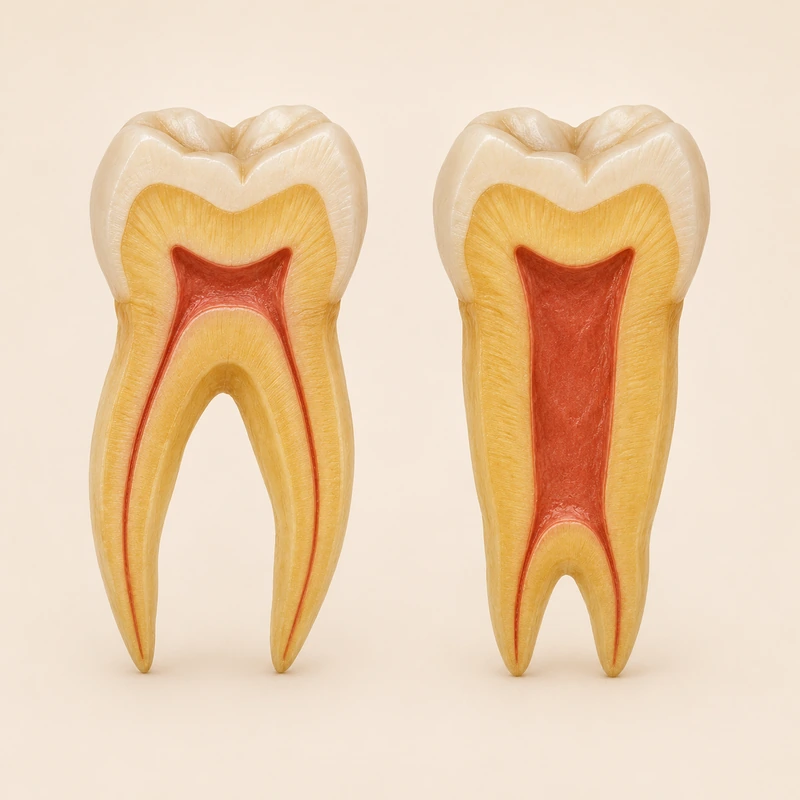
An elongated pulp chamber changes the transitions into the root canals. Taurodontism therefore means more than a tooth simply looking large.
Imaging findings and the clinical situation are considered together. Further imaging is used only when needed to answer a specific clinical question.
If root canal treatment is required, access, cleaning and filling must suit the individual anatomy. The shape alone is not a reason for treatment.
The pulp chamber and position of the root division.
Not necessarily; the crown may look ordinary.
Especially when planning endodontic treatment.
Three steps. No audio.
Each scene can also be selected manually.

Silent educational film with German on-screen text and simplified teaching images. Not a patient case or a promised treatment outcome. The full English explanation is available as text.
Macrodontia describes enlarged tooth dimensions. Taurodontism mainly concerns the pulp chamber and root division. A tooth with an ordinary external size can be taurodontic.
No. It describes a developmental variation. Decay and other disease are assessed separately.
No. Root canal treatment requires disease or another appropriate indication; the unusual shape alone is insufficient.
That depends on the findings, remaining tooth structure and treatability. The anatomy can make treatment more demanding, but does not automatically mean extraction.
You can bring this question to your appointment:
What is unusual about the pulp chamber, and would it change any treatment that is needed?
An individual examination can clarify the findings and suitable next steps.
Arrange an assessmentAppointment selection at DoctolibMacrodontia describes enlarged tooth dimensions. Taurodontism mainly concerns the pulp chamber and root division. A tooth with an ordinary external size can be taurodontic.
Editorial research: . General information, not an individual diagnosis or treatment recommendation. Teaching illustrations are simplified and do not depict a patient case.
If you turn this on, this website stores which guides you open, separately from advertising preferences. The markers expire after a fixed 30-day period from activation. The list is not sent to us by this feature. You can turn it off here and delete the markers.
Other people using the same browser profile can also see the markers. German and English versions share one marker. Expired entries are removed the next time you open a page with this feature; deleting browser data may remove them earlier. “Viewed” means opened, not read or completed.