What is the key information?
The relative positions of implant connections.

In implant dentistry, photogrammetry uses images of known markers to calculate how implant connections are positioned relative to one another in three dimensions. This information helps a team design a framework spanning several implants. Gum contours, teeth and bite may need separate records.
For training & practice ↓
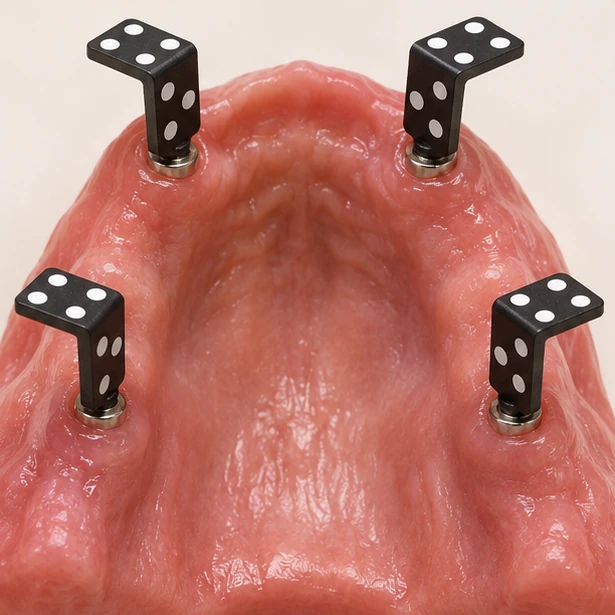
Compatible markers sit on the implants or abutments. The camera system recognises their known geometry and spatial arrangement.
Images taken from different viewpoints provide the relative position and orientation of connections. The markers must be seated correctly and visible to the system.
A separate scan can record the contours of gums and remaining teeth. These records are combined for restoration design.
The relative positions of implant connections.
The optical measurement uses light.
When a single framework must fit several implants.
Three steps. No audio.
Each scene can also be selected manually.

Silent film with English on-screen text and simplified teaching images.
Records visible surfaces with a scanner and can complement the position measurement.
A clinical photograph shows appearance and colour from one viewpoint. Implant photogrammetry uses calibrated geometry and multiple views to calculate spatial relationships.
Recording implant positions does not show how the upper and lower jaws meet. The bite relationship is recorded separately for restoration planning.
A laboratory study compared techniques on a model with six connections. Outcomes depend on the system and test setup and cannot determine the best approach for every single crown.
A question to bring along
What further records do you need for my gums and bite?
When implant restorations are planned, the team can explain which records suit your situation.
Choose a dental appointmentAppointment selection at DoctolibRecording positions, soft tissue and the bite answers three different questions.
Editorial research: . General information, not an individual diagnosis or treatment recommendation. Teaching illustrations are simplified and do not depict a patient case.
If you turn this on, this website stores which guides you open, separately from advertising preferences. The markers expire after a fixed 30-day period from activation. The list is not sent to us by this feature. You can turn it off here and delete the markers.
Other people using the same browser profile can also see the markers. German and English versions share one marker. Expired entries are removed the next time you open a page with this feature; deleting browser data may remove them earlier. “Viewed” means opened, not read or completed.