Where does it form?
At the interface between dentin and adhesive.

The hybrid layer is a microscopic transition zone. Components of an adhesive penetrate superficially demineralised dentin and harden within its remaining tissue framework.
For training & practice ↓
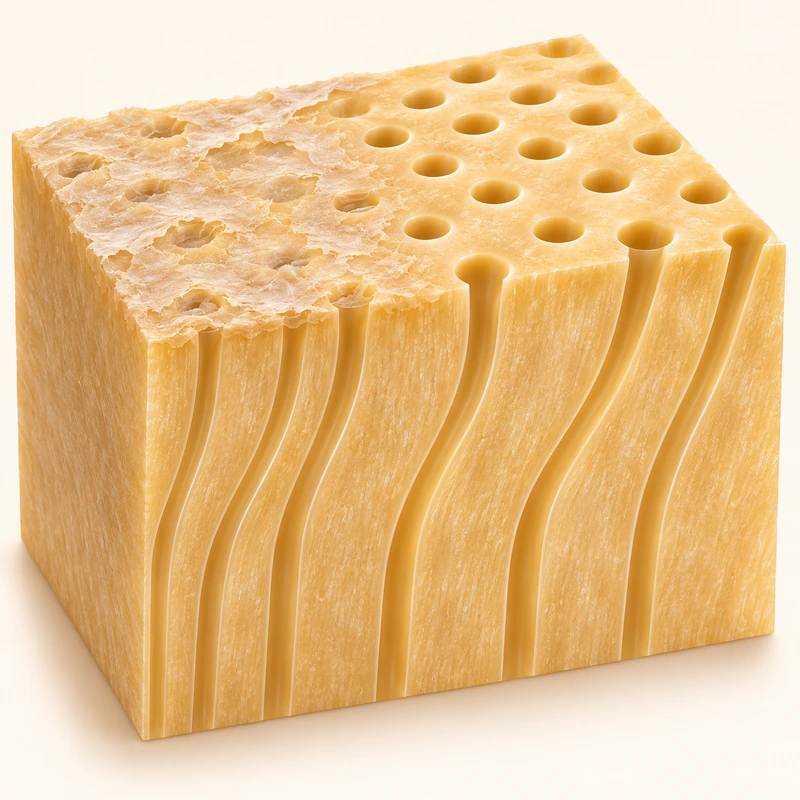
Dentin lies beneath enamel. It contains mineral, an organic framework and fine tubules. Its composition differs from enamel.
The enlarged model shows dentin alongside resin. In the tooth, infiltrated resin can surround the exposed framework of superficial dentin.
The clinician can build a bonded restoration on this interface. The transition zone in the finished tooth cannot be assessed with the naked eye.
At the interface between dentin and adhesive.
Extensions of resin into dentinal tubules.
That monomers can infiltrate conditioned dental hard tissue.
Three steps. No audio.
Each scene can also be selected manually.

Silent film with English on-screen text and simplified teaching images.
It consists of preparation debris at the dentin surface. The hybrid layer results from resin infiltration into conditioned dentin.
No. The zone forms as components of the adhesive penetrate prepared dentin and polymerise.
Resin can penetrate open dentinal tubules and form tags. The hybrid layer refers to resin-infiltrated tooth tissue between them.
No. Early laboratory work explained a bonding mechanism. An image of an interface does not predict loading in the mouth or when a particular filling will need replacement.
A question to bring along
Which tooth surfaces will the new restoration be bonded to?
You can discuss the structure of a bonded filling during treatment planning.
Choose an appointmentAppointment selection at DoctolibThe thickness of an illustrated layer does not specify the dimensions of a real clinical bond.
Editorial research: . General information, not an individual diagnosis or treatment recommendation. Teaching illustrations are simplified and do not depict a patient case.
If you turn this on, this website stores which guides you open, separately from advertising preferences. The markers expire after a fixed 30-day period from activation. The list is not sent to us by this feature. You can turn it off here and delete the markers.
Other people using the same browser profile can also see the markers. German and English versions share one marker. Expired entries are removed the next time you open a page with this feature; deleting browser data may remove them earlier. “Viewed” means opened, not read or completed.