Impression and cast
An impression captures tooth shapes. A restoration also needs the shape of the opposing arch.

The laboratory needs to know the shape of the teeth that the crown will meet. An opposing arch impression records the opposite dental arch or the relevant segment. A digital scan can supply this shape too.
For training & practice ↓
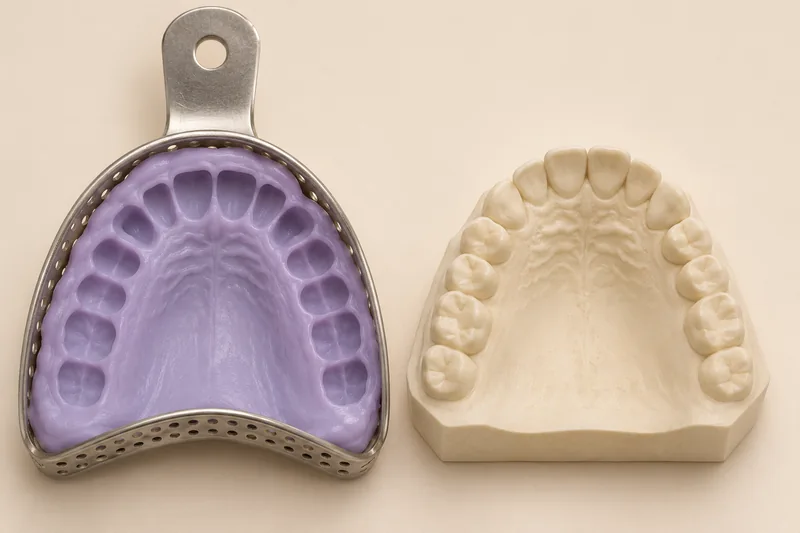
An impression captures tooth shapes. A restoration also needs the shape of the opposing arch.
A bite record relates one arch to the other in a selected jaw position.
An articulator can hold the casts in the recorded relationship during fabrication.
An impression captures tooth shapes. A restoration also needs the shape of the opposing arch.
A bite record relates one arch to the other in a selected jaw position.
An articulator can hold the casts in the recorded relationship during fabrication.
An impression captures tooth shapes. A restoration also needs the shape of the opposing arch.
A bite record relates one arch to the other in a selected jaw position.
An articulator can hold the casts in the recorded relationship during fabrication.
Three steps. No audio.
Each scene can also be selected manually.

Silent film with English on-screen text and simplified teaching images.
The impression describes the shape of the opposing teeth. A bite record relates the two arches in a selected jaw position. One description complements the other.
The impression describes the shape of the opposing teeth. A bite record relates the two arches in a selected jaw position. One description complements the other.
The extent depends on the restoration, the teeth present and the contacts that relate the arches. An approach suitable for a selected single crown may be unsuitable for extensive bridgework.
Small discrepancies can occur between the record and the finished crown. A clinical check shows how the crown sits and where it touches when you close your mouth.
A question to ask
What records does the laboratory need for my opposing arch and bite?
Choose an appointment to discuss your own tooth or restoration.
Choose an appointmentAppointment selection at DoctolibTreat the preparation, opposing arch and position of one arch relative to the other as three separate pieces of laboratory information.
Editorial research: . General information, not an individual diagnosis or treatment recommendation. Teaching illustrations are simplified and do not depict a patient case.
If you turn this on, this website stores which guides you open, separately from advertising preferences. The markers expire after a fixed 30-day period from activation. The list is not sent to us by this feature. You can turn it off here and delete the markers.
Other people using the same browser profile can also see the markers. German and English versions share one marker. Expired entries are removed the next time you open a page with this feature; deleting browser data may remove them earlier. “Viewed” means opened, not read or completed.