What should I report immediately?
Sudden severe pain or rapidly increasing swelling during or after irrigation.

Sodium hypochlorite irrigant escaping from the root canal can cause a chemical injury in surrounding tissue. Sudden severe pain and rapidly increasing swelling during or soon after treatment require immediate assessment.
For training & practice ↓
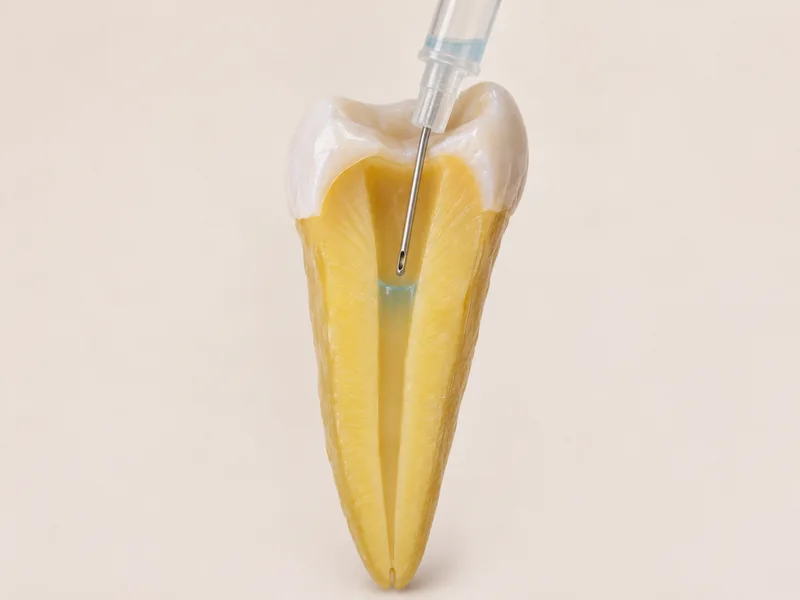
The solution is used to clean the canal. Its intended action there differs from contact with unprotected soft tissue outside the tooth.
One possible route of escape is the opening at the root tip. The anatomical model shows its relationship to nearby tissue.
The team stops irrigation, examines the pain, swelling and spread, and arranges care. Bruising may appear later.
Sudden severe pain or rapidly increasing swelling during or after irrigation.
Breathing difficulty or worsening swallowing difficulty from swelling warrants an emergency call to 112 in Germany.
The extent of swelling and any sensory changes may evolve.
Three steps. No audio.
Each scene can also be selected manually.

Silent film with English on-screen text and simplified teaching images.
Here the term describes chemical tissue injury after extrusion. Acute symptoms need immediate assessment to determine their cause.
Tenderness can have other causes. Sudden severe pain with rapidly developing swelling or bruising needs immediate assessment.
Call 112 immediately for difficulty breathing or increasing difficulty swallowing from swelling. Promptly contact the dental team or emergency dental service for swelling, severe pain or new numbness even without these signs.
Swelling and bruising can evolve. Follow-up also checks sensation and function in the affected area.
A question to bring along
Whom can I contact today if swelling or sensation changes?
Contact the practice or emergency dental service immediately for acute swelling. Call 112 for difficulty breathing.
Choose an appointmentAppointment selection at DoctolibReports of treatment incidents describe their presentation. They do not establish an individual patient’s risk.
Editorial research: . General information, not an individual diagnosis or treatment recommendation. Teaching illustrations are simplified and do not depict a patient case.
If you turn this on, this website stores which guides you open, separately from advertising preferences. The markers expire after a fixed 30-day period from activation. The list is not sent to us by this feature. You can turn it off here and delete the markers.
Other people using the same browser profile can also see the markers. German and English versions share one marker. Expired entries are removed the next time you open a page with this feature; deleting browser data may remove them earlier. “Viewed” means opened, not read or completed.