What does early mean?
The problem concerns the period when the implant should integrate with bone.

Early dental implant failure means that a stable connection between implant and bone does not develop during healing. It may be detected before the final restoration is fitted. Studies use different time limits for early failure.
For training & practice ↓
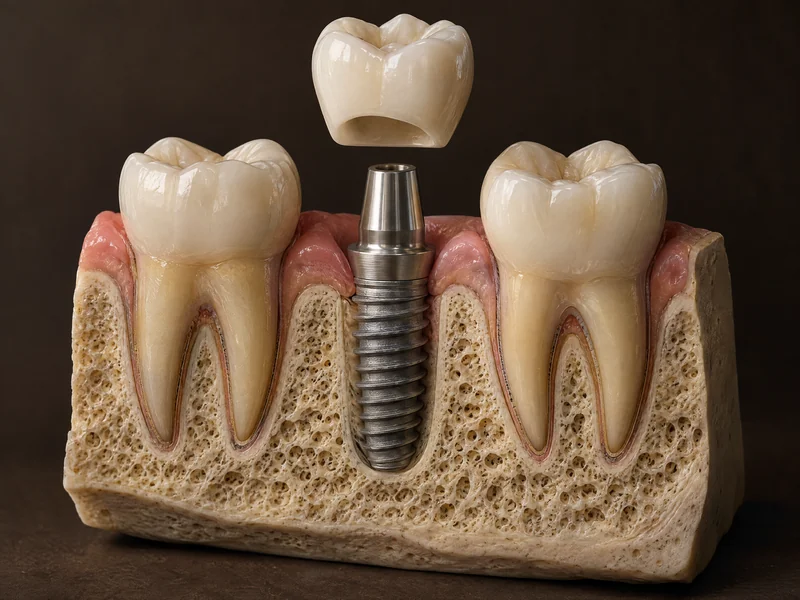
Direct contact with living bone develops after placement. Initial mechanical stability alone does not predict the outcome.
A crown or connecting screw can also loosen. The dentist checks whether the implant body itself is mobile in bone.
Increasing symptoms or a loose component warrant prompt dental assessment. The team examines soft tissue and stability and takes an X-ray when needed.
The problem concerns the period when the implant should integrate with bone.
Pain alone does not establish the diagnosis.
Avoid repeatedly pressing or rocking it and contact your dental team.
Three steps. No audio.
Each scene can also be selected manually.

Silent film with English on-screen text and simplified teaching images.
A loose abutment screw can let a restoration move while the implant remains stable. Early failure concerns the connection between the implant and bone.
Some swelling can occur after surgery. Increasing pain, pus, fever or new mobility warrant prompt assessment.
Healing depends on several local and general factors. Observational studies find associations, but rarely identify a single cause for a particular loss.
Once the site is treated, the team reassesses bone, soft tissue and possible contributing factors. Future options and timing vary by case.
If something changes during healing
Which part is affected, and what checks are appropriate now?
Report new movement around an implant promptly to your treating dentist.
Choose an appointmentAppointment selection at DoctolibA fracture or loosened screw concerns the hardware. Failure of bony integration is a biological process.
Editorial research: . General information, not an individual diagnosis or treatment recommendation. Teaching illustrations are simplified and do not depict a patient case.
If you turn this on, this website stores which guides you open, separately from advertising preferences. The markers expire after a fixed 30-day period from activation. The list is not sent to us by this feature. You can turn it off here and delete the markers.
Other people using the same browser profile can also see the markers. German and English versions share one marker. Expired entries are removed the next time you open a page with this feature; deleting browser data may remove them earlier. “Viewed” means opened, not read or completed.