Is a tissue sample needed for the reading?
The device measures a mechanical response.

The implant stability quotient is a unitless value derived from resonance frequency analysis. A device records the response of a small transducer attached to the implant. The reading reflects the stiffness of the implant and surrounding bone under the conditions of measurement.
For training & practice ↓
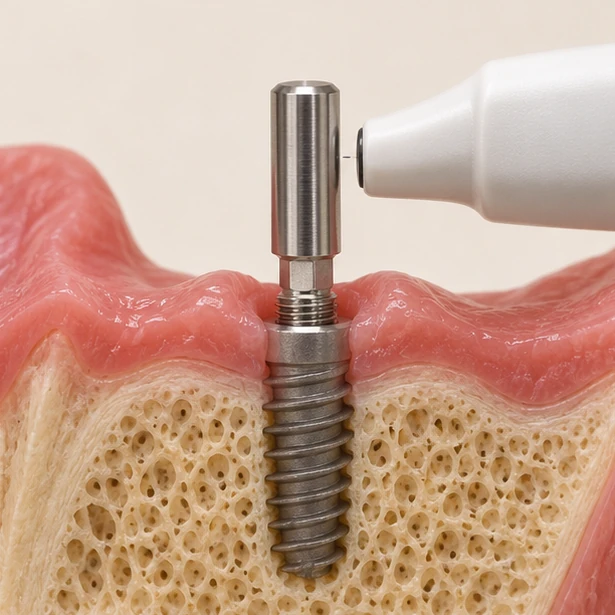
A small compatible transducer is connected to the implant for the measurement. It is visible above the gum on the teaching model.
The instrument excites the transducer and records its response. The direction from which the measurement is taken can influence the result.
Repeat readings under comparable conditions may show a change. The decision to fit a crown also takes healing and the clinical assessment into account.
The device measures a mechanical response.
When the device, transducer and direction of measurement are comparable.
Contact the treating practice promptly about pain or a feeling of looseness.
Three steps. No audio.
Each scene can also be selected manually.

Silent film with English on-screen text and simplified teaching images.
Rotational resistance during placement is expressed in Ncm.
No. It is an instrument-derived index of the measured vibration response. It cannot tell you the percentage of new bone or guarantee success.
Insertion torque measures resistance to rotation during placement in newton centimetres. Resonance analysis and torque describe different mechanical properties and may complement each other.
The dentist considers timing, symptoms, findings and the intended load. A single cutoff cannot answer this question for all implants.
A question to bring along
How does my reading fit with the course of healing so far?
The treating team assesses when the implant can take the planned load.
Choose a dental appointmentAppointment selection at DoctolibReadings at the same implant can differ between directions.
Editorial research: . General information, not an individual diagnosis or treatment recommendation. Teaching illustrations are simplified and do not depict a patient case.
If you turn this on, this website stores which guides you open, separately from advertising preferences. The markers expire after a fixed 30-day period from activation. The list is not sent to us by this feature. You can turn it off here and delete the markers.
Other people using the same browser profile can also see the markers. German and English versions share one marker. Expired entries are removed the next time you open a page with this feature; deleting browser data may remove them earlier. “Viewed” means opened, not read or completed.