Has it really sunk?
It may instead remain behind relative to growth.

Infraocclusion means that a tooth’s chewing surface lies below the level of neighbouring teeth. In children it can be associated with ankylosis of a primary tooth. The lower position alone does not establish the cause.
For training & practice ↓
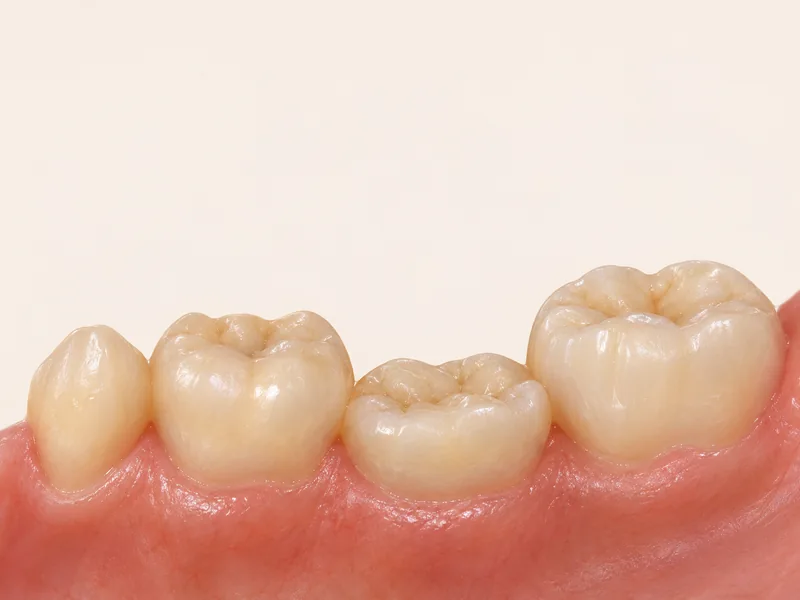
A tooth does not reach the level of neighbouring chewing surfaces. This does not necessarily mean it has physically sunk into the bone.
An ankylosed tooth may remain behind while neighbouring teeth and bone develop during growth. Other causes are possible.
Neighbouring teeth, available space and any permanent successor are assessed. Observation or treatment depends on these findings.
It may instead remain behind relative to growth.
The positional term is not restricted to primary teeth.
That depends on the whole finding.
Three steps. No audio.
Each scene can also be selected manually.

Silent educational film with German on-screen text and simplified teaching images. Not a patient case or a promised treatment outcome. The full English explanation is available as text.
Infraocclusion describes a tooth sitting below the expected chewing level. A tooth that has not emerged is a different finding; examination distinguishes them.
No. Infraocclusion describes tooth level. Ankylosis is a direct connection between root and bone without the normal periodontal ligament space at that site.
Not always. Severity, the successor, tipping and development matter. Monitoring can also be part of the plan.
Long-term planning is needed. The primary tooth’s condition, growth, space and possible future replacement are considered together; extraction is not automatic.
You can bring this question to your appointment:
Is there a permanent successor, and does the lower position affect available space?
An examination can clarify the finding and any need for referral.
Arrange an assessmentAppointment selection at DoctolibInfraocclusion describes a tooth sitting below the expected chewing level. A tooth that has not emerged is a different finding; examination distinguishes them.
Editorial research: . General information, not an individual diagnosis or treatment recommendation. Teaching illustrations are simplified and do not depict a patient case.