When is it used?
For example, when a matrix is used for a filling on a side surface of a tooth.

An interdental wedge is a small aid temporarily placed between neighbouring teeth by the clinician. For a filling on the side of a tooth, it helps adapt and stabilise a matrix band near the gum margin. It may also contribute to slight separation of the teeth. Its size, shape and interaction with the matrix must suit the particular situation.
For training & practice ↓
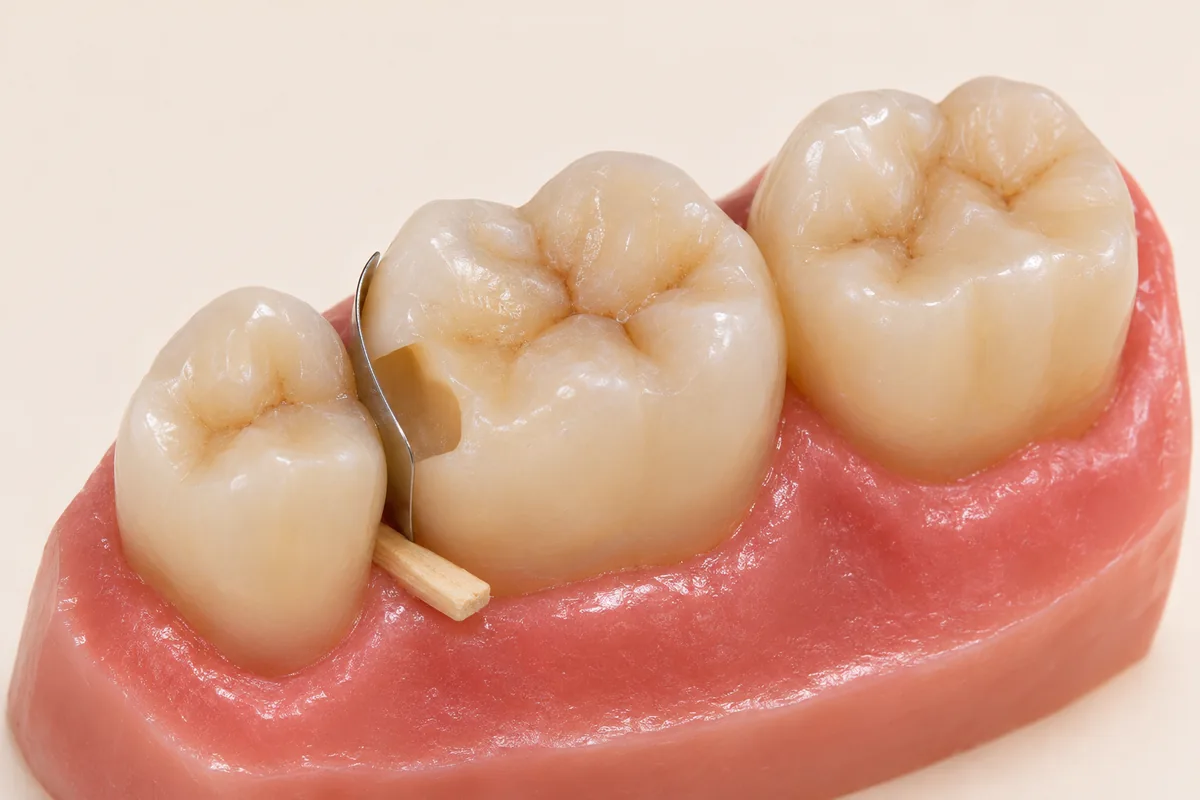
When decay has removed part of a side wall, a matrix band temporarily contains the filling material. Adaptation at the deeper margin is particularly important.
A suitable wedge sits between the teeth below the contact area. It helps adapt the matrix at the cervical margin. Depending on the system, a separating ring may also be used.
The wedge and matrix are removed during treatment. Checks then include the shape of the margin and contact with the neighbouring tooth. The wedge does not remain as part of the filling.
For example, when a matrix is used for a filling on a side surface of a tooth.
No. It is removed during the course of treatment.
The filling margin and contact with the neighbouring tooth, among other features.
Three steps. No audio.
Each scene can also be selected manually.

Silent educational film with German on-screen text and simplified teaching images. Not a patient case or a promised treatment outcome. The full English explanation is available as text.
The matrix temporarily contains the filling material. The wedge supports its adaptation between the teeth. They have different functions.
No. A filling wedge is a clinical instrument. It does not replace floss or a suitably sized interdental brush and is not intended for self-placement.
An unsuitable wedge may fail to adapt the matrix or distort it unfavourably. Selection depends on the space, the cavity and the matrix system.
No. It supports shaping but does not replace assessment of the whole restoration. The matrix, material handling and access also affect the result.
You can bring this question to your appointment:
How will the contact with the neighbouring tooth and a cleanable margin be checked for my filling?
If a filling is planned or food becomes trapped between teeth after treatment, you can have the contact area assessed.
Discuss your findingsAppointment selection at DoctolibThe matrix temporarily contains the filling material. The wedge supports its adaptation between the teeth. They have different functions.
Editorial research: . General information, not an individual diagnosis or treatment recommendation. Teaching illustrations are simplified and do not depict a patient case.