How might it be noticed?
A local enlargement seen on a dental X-ray.

In internal resorption, the body’s own cells remove dentine from the wall of the root canal. The canal can become wider in one area as the surrounding root wall thins.
For training & practice ↓
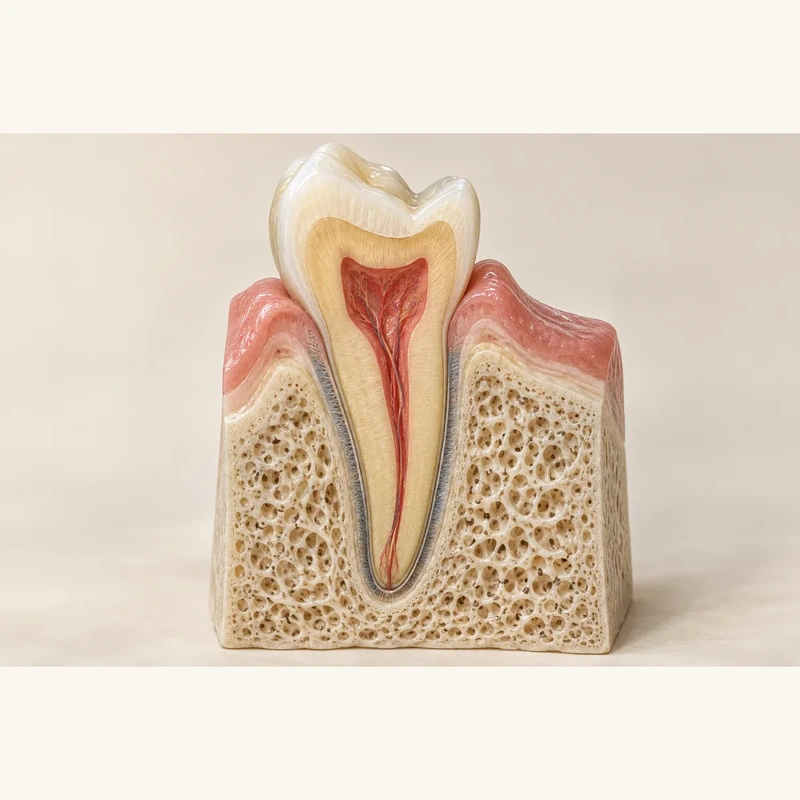
In a healthy root the canal is bounded by dentine. Inflammatory internal resorption begins at this inner surface.
A small recess can grow into a larger cavity. If it reaches the outer root surface it creates a communication with the supporting tissues.
Root canal treatment may remove the tissue sustaining active inflammatory resorption. The irregular space can complicate cleaning and sealing.
A local enlargement seen on a dental X-ray.
At the inner wall of the canal.
The remaining dentine between the defect and outer root surface.
Three steps. No audio.
Each scene can also be selected manually.

Silent film with English on-screen text and simplified teaching images.
External resorption starts at the root surface. The approach depends on its type and extent.
Some lesions are found on an X-ray taken for another reason. Absence of pain says little about the thickness of the root wall.
Views from different angles can show whether the lesion stays centred on the canal. Selected cases benefit from a small-field three-dimensional scan to judge its extent.
The loss of dentine has breached the root wall. Whether the communication can be sealed depends partly on its size and position.
A question to bring along
How large is the defect and has it reached the outer root surface?
Bring previous dental images to the appointment for comparison.
Choose an appointmentAppointment selection at DoctolibReplacement resorption can deposit hard tissue within the internal defect. A more uniformly dark enlargement is typical of the inflammatory form.
Editorial research: . General information, not an individual diagnosis or treatment recommendation. Teaching illustrations are simplified and do not depict a patient case.
If you turn this on, this website stores which guides you open, separately from advertising preferences. The markers expire after a fixed 30-day period from activation. The list is not sent to us by this feature. You can turn it off here and delete the markers.
Other people using the same browser profile can also see the markers. German and English versions share one marker. Expired entries are removed the next time you open a page with this feature; deleting browser data may remove them earlier. “Viewed” means opened, not read or completed.