Is an apparently missing tooth always knocked out?
It may have been pushed deeply into bone.

Intrusive luxation occurs when an impact drives a tooth further into the jaw towards its root tip. Less of the crown may remain visible. A recent injury needs urgent dental assessment.
For training & practice ↓
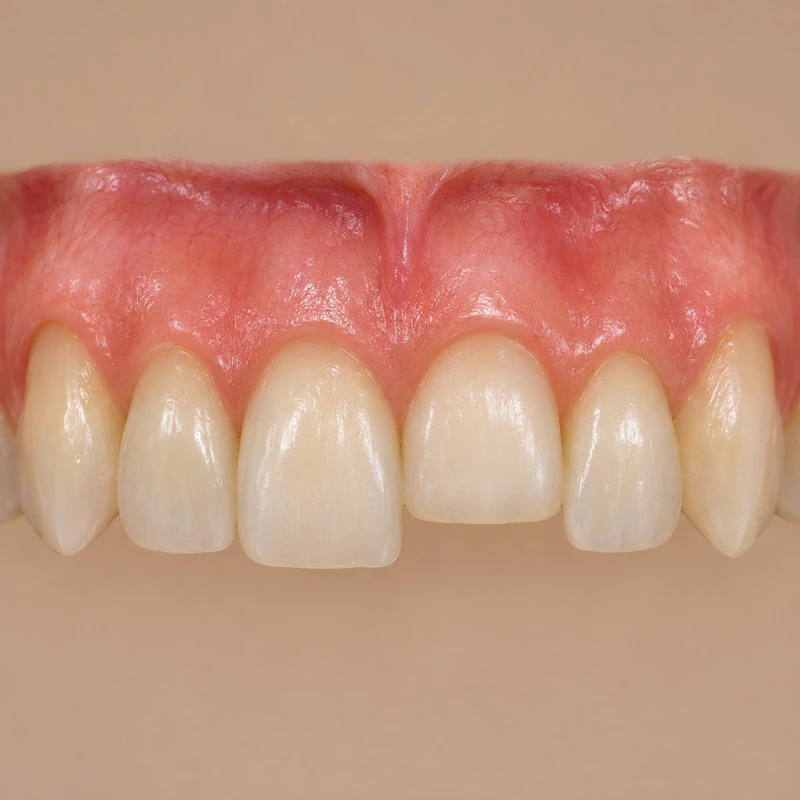
The crown sits deeper than its neighbour. With severe intrusion the tooth may appear to be missing while still inside the jaw.
The impact can injure the ligament around the root and the socket wall. An intruded tooth may feel locked in place.
In a permanent tooth, intrusion depth and root maturity help determine whether monitored re-eruption or active repositioning is appropriate. The dental team makes this decision.
It may have been pushed deeply into bone.
Leave it alone and call a dentist or urgent dental service immediately.
The team monitors position, pulp health and signs of root resorption.
Three steps. No audio.
Each scene can also be selected manually.

Silent educational film with German on-screen text and simplified teaching images. Not a patient case or a promised treatment outcome. The full English explanation is available as text.
The orthodontic term describes controlled movement. Sudden displacement from an impact is an injury requiring a different assessment.
It may have been pushed deeply into bone. Examination and suitable imaging determine its location.
Leave it alone and call a dentist or urgent dental service immediately. Repositioning requires professional assessment.
The team monitors position, pulp health and signs of root resorption. Symptoms can develop later.
Primary teeth have their own injury guidance. Tell the dental team the child's age and which tooth may be affected.
A question you could ask
How far was the tooth displaced and how mature was its root?
After a recent dental injury, call a dental practice or an emergency dental service promptly.
Call the practice · 0221 669 401 80Telephone contactThe orthodontic term describes controlled movement. Sudden displacement from an impact is an injury requiring a different assessment.
Editorial research: . General information, not an individual diagnosis or treatment recommendation. Teaching illustrations are simplified and do not depict a patient case.
If you turn this on, this website stores which guides you open, separately from advertising preferences. The markers expire after a fixed 30-day period from activation. The list is not sent to us by this feature. You can turn it off here and delete the markers.
Other people using the same browser profile can also see the markers. German and English versions share one marker. Expired entries are removed the next time you open a page with this feature; deleting browser data may remove them earlier. “Viewed” means opened, not read or completed.