What takes up the stain?
Certain areas of the dentine matrix.

Caries detector dye is a colouring agent that can stain particular dentine areas during treatment. It aids visual assessment but does not directly measure bacterial numbers. Less mineralised dentine that is not necessarily infected may also take up the stain. Colour alone therefore does not determine how much tooth tissue should be removed.
For training & practice ↓
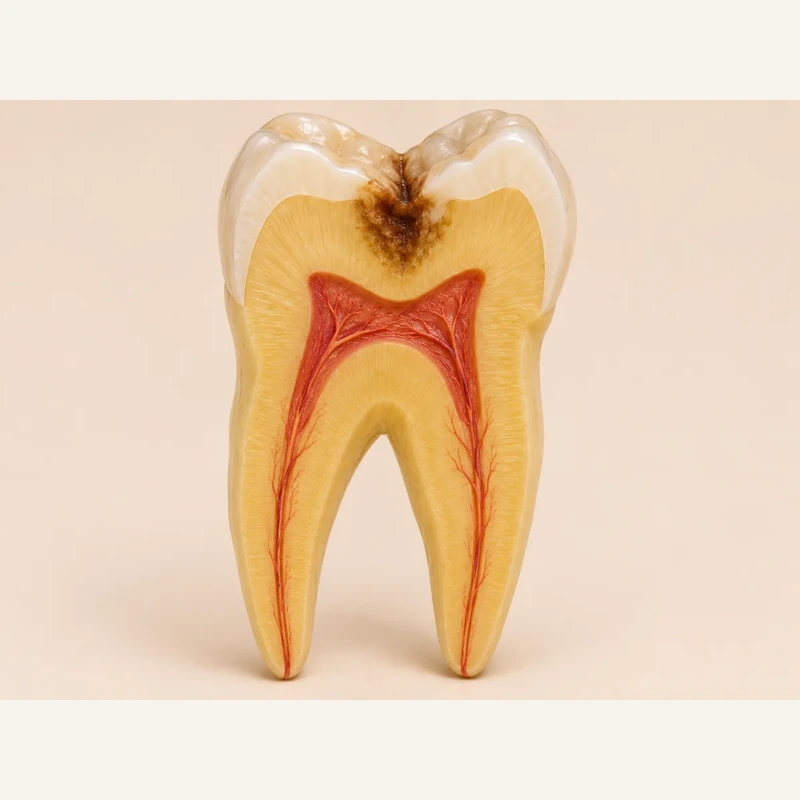
The dye can bind to components of the dentine matrix. Stained tissue is not automatically an exact map of the bacterial infection front.
The findings, tissue hardness and proximity to the pulp also matter. Appropriate deep lesions may be managed conservatively to preserve tissue.
Assessment combines examination with imaging when required. The aim is suitable treatment, not making a cavity completely colourless at any cost.
Certain areas of the dentine matrix.
No.
The findings, lesion depth, tissue assessment and pulp preservation.
Three steps. No audio.
Each scene can also be selected manually.

Silent educational film with German on-screen text and simplified teaching images. Not a patient case or a promised treatment outcome. The full English explanation is available as text.
Caries dyes are discussed here for assessing dentine during treatment. Plaque disclosing agents reveal deposits on tooth surfaces. Stained plaque does not measure dentine caries.
No. That could remove unnecessary tooth tissue and endanger the pulp. Removal follows the overall findings and treatment approach.
No. A dye test cannot replace clinical assessment. Its value and limits also depend on the product and its use.
No. Dyes and optical measuring devices use different methods. Both provide additional information rather than a diagnosis independent of all other findings.
You can bring this question to your appointment:
How is the dye result combined with depth and hardness to help preserve sound tooth tissue?
An individual examination can clarify the findings and suitable next steps.
Arrange an assessmentAppointment selection at DoctolibCaries dyes are discussed here for assessing dentine during treatment. Plaque disclosing agents reveal deposits on tooth surfaces. Stained plaque does not measure dentine caries.
Editorial research: . General information, not an individual diagnosis or treatment recommendation. Teaching illustrations are simplified and do not depict a patient case.
If you turn this on, this website stores which guides you open, separately from advertising preferences. The markers expire after a fixed 30-day period from activation. The list is not sent to us by this feature. You can turn it off here and delete the markers.
Other people using the same browser profile can also see the markers. German and English versions share one marker. Expired entries are removed the next time you open a page with this feature; deleting browser data may remove them earlier. “Viewed” means opened, not read or completed.