Where is it worn?
In front of the face, with forehead and chin support.

An orthodontic facemask is an external traction appliance supported on the forehead and chin. Elastics connect its frame to an appliance on the upper jaw. In selected bite problems it is intended to encourage forward development or positioning of the upper jaw. Suitability depends on the jaw relationship and remaining growth, among other factors.
For training & practice ↓
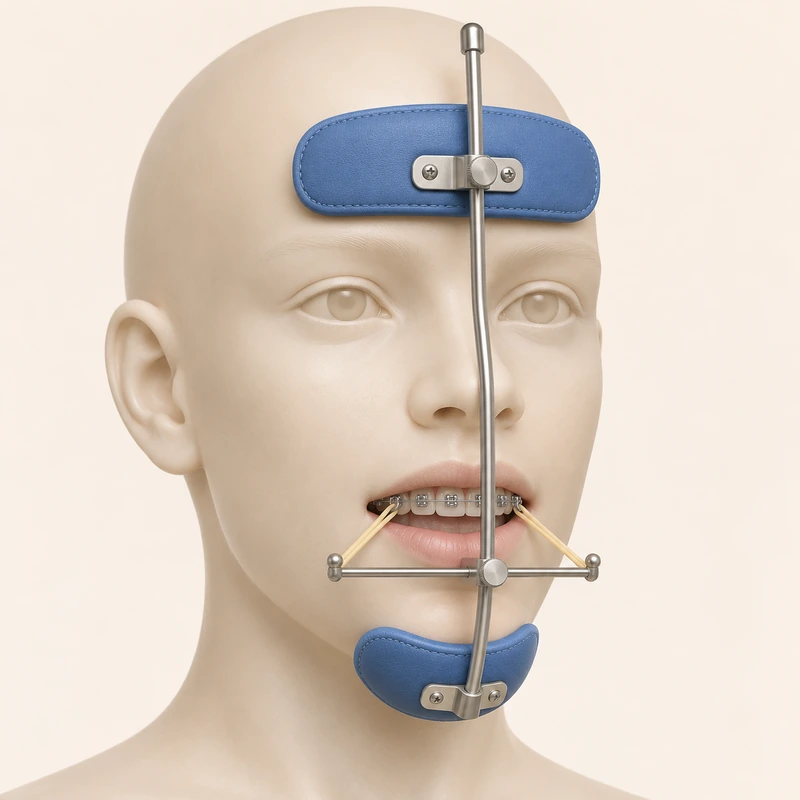
Forehead and chin pads support the frame. Elastics transfer force to an upper-jaw appliance. The target and direction of force are planned from the individual orthodontic findings.
An underbite can reflect a retrusive upper jaw, a prominent lower jaw or both. A facemask is therefore not automatically suitable for every visible underbite.
Wear time, fitting and removal are taught personally. Report rubbing, damage or loose parts promptly. Further braces may still be needed later.
In front of the face, with forehead and chin support.
On the planned upper-jaw appliance.
No such promise can be made.
Three steps. No audio.
Each scene can also be selected manually.

Silent educational film with German on-screen text and simplified teaching images. Not a patient case or a promised treatment outcome. The full English explanation is available as text.
Both are extraoral appliances. A facemask typically aims to bring the upper jaw forward. Other headgear types have different anchorage and force directions and are not interchangeable.
No. An orthodontic facemask transfers forces to the upper jaw. It is not a breathing mask or a general treatment for snoring.
Daily wear and total treatment duration are prescribed and reviewed individually. Age, growth, the starting condition and actual wear affect progress; no fixed duration can be promised here.
No. Tooth alignment and further jaw growth need follow-up. Other treatment may still be necessary after early intervention.
Contact the treating orthodontic team promptly and follow their advice. Do not bend the frame or change the force yourself; follow the safety instructions given for sport and other activities.
You can bring this question to your appointment:
Which part of my bite problem is the facemask intended to address, and how will further growth be monitored?
An individual examination can clarify the findings and suitable next steps.
Arrange an assessmentAppointment selection at DoctolibBoth are extraoral appliances. A facemask typically aims to bring the upper jaw forward. Other headgear types have different anchorage and force directions and are not interchangeable.
Editorial research: . General information, not an individual diagnosis or treatment recommendation. Teaching illustrations are simplified and do not depict a patient case.
If you turn this on, this website stores which guides you open, separately from advertising preferences. The markers expire after a fixed 30-day period from activation. The list is not sent to us by this feature. You can turn it off here and delete the markers.
Other people using the same browser profile can also see the markers. German and English versions share one marker. Expired entries are removed the next time you open a page with this feature; deleting browser data may remove them earlier. “Viewed” means opened, not read or completed.